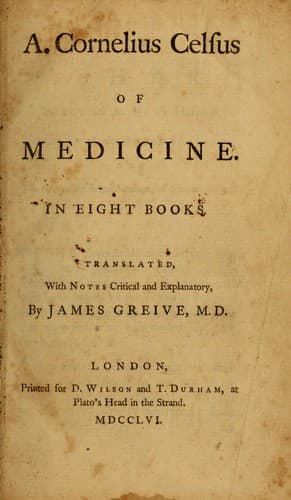
Of Medicine, in Eight BooksCelsus, Aulus Cornelius
History
Of Medicine, in Eight Books
Celsus, Aulus Cornelius
Medicine, Greek and Roman
The same composition is useful for the gout in the foot. But for that
ailment Ariston has also composed one, containing of nard, cinnamon,
cassia, chamaeleon, round cyperus, each p. viii. *. goat’s suet melted
in iris ointment p. xx. *. iris p. i. *. which ought to lie in the
strongest vinegar for twenty days. The same also discusses recent
tubercles, and all pains.
[Sidenote: _34. Theoxenus’s for pained feet._]
But for pains of the feet Theoxenus mixed, of kidney suet a third part,
of salt two parts, and applied them spread upon a piece of leather;
then put over it ammoniacum thymiama dissolved in vinegar.
[Sidenote: _35. Numenius’s for the gout, &c._]
But Numenius mollified the gout in the feet, and other indurated joints
with the following composition: southernwood, dry roses, poppy-tears,
of each p. iii. *. turpentine resin p. iv. *. frankincense, aphronitre,
each p. viii. * iris, birthwort, each p. xii. *. wax p. iii. * to these
is added one cyathus of cedria(44), three cyathi of laurel oil(45),
and a sextarius of bitter oil.
[Sidenote: _36. Dexius’s malagma for a callus, &c._]
For a callus formed upon the joints, Dexius directed the following
application: of lime, p. iv. *. ceruss, p. viii. *. pine resin xx.
*. pepper thirty grains, wax p. ii. *. And while these are beat up a
hemina of mild wine is poured in.
CHAP. XIX.
OF PLAISTERS.
Of plaisters there are none more useful, than those, which are
immediately applied to bloody wounds; the Greeks call them enaima[DW].
For these repel an inflammation, unless it be excited by something very
violent, and even then they diminish its force, and agglutinate wounds,
which are not inflamed, and cicatrize them. They consist of medicines
not fat, and therefore by the Greeks are called alipaina[DX].
[DW] ἔναιμα.
[DX] ἀλίπαινα.
[Sidenote: _1. Barbarium plaister._]
The best of these plaisters is that, which is called barbarum. It
contains of rasile verdigrease(46) p. xii. *. litharge p. xx. *.
alum, dry pitch, dry pine resin, each p. i. *. to which is added of oil
and vinegar each a hemina.
[Sidenote: _2. The choacon._]
There is another for the same, which is called choacon; it contains of
litharge p. x. *. dry resin as much. But the litharge is first boiled
in three heminæ of oil. The colour of both these plaisters is black,
which generally results from pitch and resin, as the blackest is from
bitumen; from verdigrease, or scales of copper, green; from minium,
red; from ceruss, white.
[Sidenote: _3. The basilicon._]
There are a very few compositions, in which the variety of the mixture
causes some different appearance; therefore that also is black, which
is called basilicon. It contains of opopanax p. i. *. galbanum p. ii.
*. pitch and resin, of each p. x. *. half a cyathus of oil.
[Sidenote: _4. The smaragdine._]
Public-domain text, read in full here on John Shaqi.
Reviews
Reviews
No reviews yet
Be the first to share your thoughts on this work.
Elsewhere in the archive
Join the Discussion
Join the discussion
Sign in to leave a comment or review.
Sign InorCreate an account