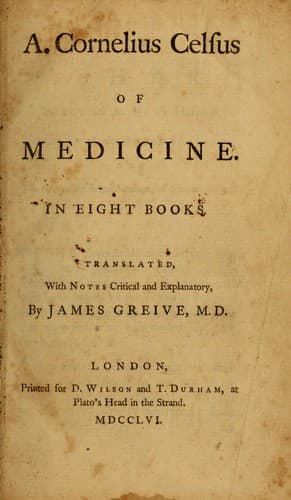
Of Medicine, in Eight BooksCelsus, Aulus Cornelius
History
Of Medicine, in Eight Books
Celsus, Aulus Cornelius
Medicine, Greek and Roman
There is then the Attalum plaister for wounds: which contains of copper
scales p. vii. *. soot of frankincense p. xv. *. ammoniacum as much,
liquid turpentine resin p. xxv. *. beef suet the same quantity, three
heminæ of vinegar, a sextarius of oil.
[Sidenote: _12. Judæus’s plaister._]
But amongst those, which are proper for a fractured skull, some use
that, which is said to be invented by Judæus. It consists of the
following ingredients: salt p. iv. *. red copper scales, calcined
copper, each p. xii. *. ammoniacum thymiama, soot of frankincense, dry
resin, each p. vi. *. Colophonian resin, wax, veal suet cured, each p.
xx. *. a cyathus and half of vinegar is added, and less than a cyathus
of oil. What the Greeks call tetherapeumena[EC], we call curata,
_cured_; when for instance from the suet all the little membranes are
carefully taken away, and so in any other medicine.
[EC] τεθεραπευμένα.
[Sidenote: _13. Diadaphnidon._]
There are also some plaisters greatly celebrated for drawing, which
are likewise distinguished by the name of epispastica[ED]. Such as is
that, which because bay-berries are among the ingredients, is called
diadaphnidon[EE]. In it there is turpentine resin p. x. *. nitre, wax,
dry pitch, bay-berries, each p. xx. *. and a little oil. Now as often
as I shall mention a berry or a nut, or any thing of that nature,
it will be proper to know, that before it be weighed, the exterior,
pellicle is to be taken from it.
[ED] ἐπισπαστικὰ.
[EE] διὰ δαφνίδων.
[Sidenote: _14. Another._]
There is another of the same name, which is also for promoting a
suppuration. Of veal suet, ammoniacum thymiama, pitch, wax, nitre,
bay-berries, dry resin, birthwort, pellitory, of each equal parts.
[Sidenote: _15. Philocrates’s._]
Besides these there is one of Philocrates: which contains sal ammoniac
p. vii. *. birthwort p. viii. *. wax, turpentine resin, soot of
frankincense, each p. xv. *. litharge p. xxxii. *. To these, that it
may serve also for promoting a suppuration, are added iris p. iii. *.
galbanum p. vi. *.
[Sidenote: _16. Rhypodes._]
However that is best for drawing, which from its resemblance to sordes,
the Greeks call rhypodes[EF]. It contains myrrh, saffron, iris,
propolis, bdellium, the heads of pomegranates, scissile and round
alum, misy, chalcitis, boiled copperas(48), opopanax, sal ammoniac,
viscum, each p. iv. *. birthwort p. viii. *. copper scales p. xvi. *.
turpentine resin p. lxxv. *. wax, and suet, either beef or goat’s, each
p. c. *.
[EF] ῥυπω̃δες.
[Sidenote: _17. Hecatæus’s._]
Hecatæus also is the author of a plaister of the same kind, which is
thus composed: galbanum p. ii. *. soot of frankincense p. iv. *. pitch
p. v. *. wax and turpentine resin, each p. viii. *. with these a little
iris ointment is mixed.
[Sidenote: _18. The green Alexandrian._]
Public-domain text, read in full here on John Shaqi.
Reviews
Reviews
No reviews yet
Be the first to share your thoughts on this work.
Elsewhere in the archive
Join the Discussion
Join the discussion
Sign in to leave a comment or review.
Sign InorCreate an account