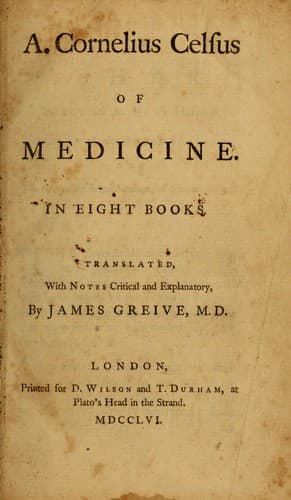
Of Medicine, in Eight BooksCelsus, Aulus Cornelius
History
Of Medicine, in Eight Books
Celsus, Aulus Cornelius
Medicine, Greek and Roman
The green Alexandrian drawing plaister is efficacious for the same
purpose. It contains scissile alum p. viii. *. sal ammoniac p. vii. *.
copper scales p. xvi. *. myrrh, frankincense, each p. xviii. *. wax
p. cl. *. colophonian or pine resin p. cxc. *. a hemina of oil, and a
sextarius of vinegar.
[Sidenote: _19. An eating plaister._]
Some plaisters are eating, which the Greeks call septica[EG], such as
is that, which contains turpentine resin, soot of frankincense, of each
p. ii. *. copper scales p. i. *. labdanum p. ii. * the same quantity of
alum, litharge p. iv. *.
[EG] σηπτικὰ.
[Sidenote: _20. Another for eating, &c._]
This plaister also eats away flesh vehemently, and even dissolves
the bones, and keeps down fungous flesh. It contains litharge,
copper scales, of each an ounce; nitre that has not felt the fire,
Asian stone, birthwort, of each a sextans, wax, turpentine resin,
frankincense, old oil, copperas, sal ammoniac, 1/2 p. rasile
verdigrease p. bessis, of squill vinegar a hemina, and a like quantity
of Aminæan wine.
[Sidenote: _21. Diogenes’s black plaister._]
There are also some calculated against bites; such as the black one of
Diogenes: which contains of bitumen, wax, dry pine resin, each p. xx.
*. litharge p. c. *. of oil a sextarius. Or that, which consists of
copper scales p. iv. *. ceruss and rasile verdigrease each p. viii. *.
ammoniacum p. xii. *. wax, pine resin, each p. xxv. *. litharge p. c.
*. of oil a sextarius. Or that, which is composed of copper scales p.
xiv. *. galbanum p. vi. *. ceruss and rasile verdigrease, each p. viii.
*. ammoniacum p. xii. *. wax, pine resin, of each p. lv. *. with these
the litharge is boiled.
[Sidenote: _22. Red Ephesian plaister._]
There is a red plaister of the same virtues, which is called Ephesian.
It contains turpentine resin p. ii. *. galbanum p. iv. *. Sinopian
minium p, vi. *. soot of frankincense p. vi. *. wax p. viii. *.
litharge, p. lvi. *. old oil a hemina.
[Sidenote: _23. Another._]
Likewise that which consists of the following materials; copper scales,
soot of frankincense, of each p. iv *. galbanum p. vi. *. sal ammoniac
p. xii. z. *. wax p. xxv. *. with three heminæ of oil. These also are
proper applications for other recent wounds.
[Sidenote: _24. A white lenient plaister._]
There are also white lenient plaisters, by the Greeks, _from their
colour_, called leuca[EH], generally calculated for slight wounds, and
especially those of old men: such as is that, which contains of ceruss
p. lii. *. veal suet cured and wax, each p. lviii. *. three heminæ of
oil, with which the ceruss is boiled up.
[EH] λευκὰ.
[Sidenote: _25. Elephantine plaister._]
Another, which consists of ceruss p. xx. *. wax p. lv. *. a hemina of
oil, and a sextarius of water. Now as often as these are added, to
ceruss or litharge, we may take it for granted, that they are to be
boiled with them. This last composition is very white, and therefore it
is called elephantine.
Public-domain text, read in full here on John Shaqi.
Reviews
Reviews
No reviews yet
Be the first to share your thoughts on this work.
Elsewhere in the archive
Join the Discussion
Join the discussion
Sign in to leave a comment or review.
Sign InorCreate an account