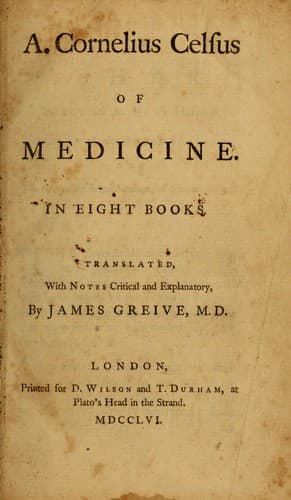
Of Medicine, in Eight BooksCelsus, Aulus Cornelius
History
Of Medicine, in Eight Books
Celsus, Aulus Cornelius
Medicine, Greek and Roman
[Sidenote: _26. A lenient plaister._]
There are also some lenient plaisters, which the Greeks commonly call
lipara[EI], as that which contains minium p. iv.*. litharge, p. xxv. *.
wax and hog’s lard, each p. xxxv. *. and the yolks of four eggs.
[EI] λιπαρὰ.
[Sidenote: _27. Another._]
Another composition of the same kind: wax, turpentine resin, of each
p. v. *. ceruss p. viii. *. litharge, dross of lead (scoria molybdi
the Greeks call it) each p. x. *. cicine(49) and myrtle oil, each the
third part of a hemina.
[Sidenote: _28. Archagathus’s._]
Another, which is said to be invented by Archagathus: burnt misy,
calcined copper, each p. iv. *. burnt(50) ceruss p. viii. *.
turpentine resin p. x. *. litharge p. vi. *.
[Sidenote: _29. Another for the same purpose._]
For the same purpose: litharge, wax, hog’s lard, of each p. xxvii. *.
boiled yolks of eggs, with a hemina of rose oil. Or this composition:
cerate made of myrtle oil three parts, hog’s lard a fourth part, a
little lead dross. Or the following composition; of litharge half a
pound boiled with a hemina of oil, and a like quantity of sea water,
till it cease to bubble, with the addition of a little wax. Or this:
equal parts of wax, suet, antimony, litharge, and ceruss.
CHAP. XX.
OF TROCHES.
[Sidenote: _1. Troche for agglutinating._]
Troches also have different virtues. For there are some adapted to
agglutinate and heal recent wounds: such is that, which contains
chalcitis, misy, aphro-nitre, flower of copper, galls, scissile alum
moderately burnt, of each p. i. *. calcined copper, the heads of
pomegranates, each p. iii. *. This should be diluted with vinegar, and
so laid on, when a wound is to be agglutinated. But if it be a nervous
or muscular part, it is better to mix it with cerate, so as to have a
ninth part of the latter with eight of the other.
[Sidenote: _2. Another._]
Another for the same purpose. It consists of the following materials:
bitumen, scissile alum, of each p. i. *. calcined copper p. iv. *.
litharge p. xi. *. and a sextarius of oil.
[Sidenote: _3. The sphragis of Polybus._]
But that of Polybus(51) is by far the most celebrated: it is called
sphragis[EJ]. Which contains of scissile alum p. iv. *. copperas p. ii.
*. myrrh p. v. *. aloes a like quantity; the heads of pomegranates, ox
gall, each p. vi. *. which being rubbed together, are incorporated with
austere wine.
[EJ] σφραγὶς.
[Sidenote: _4. Troche for foul ulcers._]
For foul ulcers, and blackness in the ears, nose, obscene parts, and
inflammation in any of these places: of chrysocolla p. i. *. copperas,
scissile alum, each p. ii. *. bark of winter cherry p. iv. *. minium p.
vi. *. litharge p. xii. *. ceruss p. xvi. *. these are compounded with
vinegar, and diluted when used.
[Sidenote: _5. Andro’s troche._]
Public-domain text, read in full here on John Shaqi.
Reviews
Reviews
No reviews yet
Be the first to share your thoughts on this work.
Elsewhere in the archive
Join the Discussion
Join the discussion
Sign in to leave a comment or review.
Sign InorCreate an account