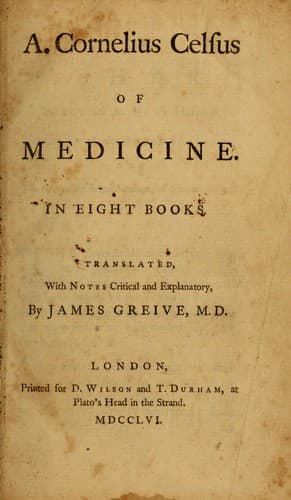
Of Medicine, in Eight BooksCelsus, Aulus Cornelius
History
Of Medicine, in Eight Books
Celsus, Aulus Cornelius
Medicine, Greek and Roman
The nature of the wound also and its figure make some difference; for
when a part is both cut and bruised, it is worse than when it is only
cut asunder; so that it is better to be wounded by a sharp weapon, than
a blunt one. And that wound is worse, out of which any substance is
cut, or where the flesh is carried off on one part, and hangs on the
other. In general, those wounds are the worst, that are crooked: and
those safest that are of a straight direction. And then, the nearer the
wound approaches to the first or second of these forms, it is more or
less dangerous.
[Sidenote: _Consideration of the age, constitution, and season._]
Moreover the age, constitution, the way of life _of the patient_,
and the season of the year, are of some importance: for a boy or a
youth recovers more easily than one that is older; the strong than
the infirm; one, that is neither too slender nor too plethoric, than
one, that is on either of these extremes; one of a sound than one of
a corrupt habit; one, that takes exercise, than an indolent person;
the sober and temperate than one given to wine and venery. Again, the
most convenient season of the year for curing a wound is the spring; or
at least when it is neither hot nor cold: for both excessive heat and
intense cold are prejudicial to wounds; but most of all an alternate
change of these: and for that reason the autumn is very hurtful.
[Sidenote: _Of wounds of the internal parts._]
Most wounds are exposed to our view: but there are some, of which we
judge from the situation of the parts, which we explained elsewhere,
when we demonstrated the position of the internal parts. Nevertheless,
because some of these lie superficial, and it makes a difference,
whether a wound be in the surface, or has penetrated deeper; it is
necessary to mention the appearances, by which we may know what is
hurt within; and from which we are either to hope or despair.
[Sidenote: _Symptoms of the heart being wounded._]
When the heart is wounded, there is a great effusion of blood, the
pulse is languid, the skin very pale, cold sweats with a bad smell
come on, the same as in sickness: the extremities grow cold, and death
quickly follows.
[Sidenote: _Of the lungs._]
When the lungs are wounded, there is a difficulty of breathing; frothy
blood is discharged from the mouth, and red blood from the wound; also
along with the latter the air issues with a noise; the patient has an
inclination to lie upon the wound; some start up without any reason.
Many when they are lying upon the wound, are able to speak: if upon
another part, they lose that faculty.
[Sidenote: _Of the liver._]
Public-domain text, read in full here on John Shaqi.
Reviews
Reviews
No reviews yet
Be the first to share your thoughts on this work.
Elsewhere in the archive
Join the Discussion
Join the discussion
Sign in to leave a comment or review.
Sign InorCreate an account