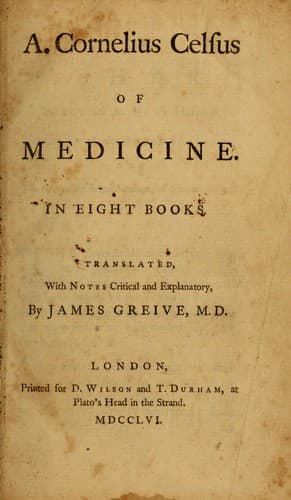
Of Medicine, in Eight BooksCelsus, Aulus Cornelius
History
Of Medicine, in Eight Books
Celsus, Aulus Cornelius
Medicine, Greek and Roman
it be fetid; unless the smell arises from the nature of the particular
part, where the ulcer is. The less there is of it, and the thicker,
and whiter, so much the better; and also if it be smooth, if it have
no smell, if it be homogeneous. In quantity, however, it ought to
correspond both with the size and age of the wound: for a greater
quantity is discharged naturally from a larger one; and more before the
inflammation is removed, than afterwards. Elæodes also when plentiful,
and containing but little fat, is bad: but the less there is of it, and
the more oily so much the better.
[EO] ἰχὼρ.
[EP] μελίκηρα.
[EQ] ἐλαιω̃δες.
[Sidenote: _Cure of a hæmorrhage from a wound._]
These things being considered, when any person is wounded, that can
be cured, two things are immediately to be regarded: that he do not
perish either by a hæmorrhage, or an inflammation. If we are afraid of
a hæmorrhage (which may be known from the situation of the wound and
its largeness, and from the force of the stream of blood) the wound
is to be filled with dry lint, and over it a sponge squeezed out of
cold water must be applied, and pressed down with the hand. If this
does not stop the blood, the lint is to be frequently changed: and if
it have not strength enough dry, it must be moistened with vinegar.
This is very powerful in stopping blood: and therefore some people
pour it into the wound. But here again it is to be feared, that the
matter being too forcibly retained there, may afterwards raise a great
inflammation. Which is the reason why neither corroding medicines,
nor such as are caustic, and therefore forming a slough, are to be
used, although most of these stop blood: but if recourse is ever had
to them, such ought rather to be employed, as are the mildest in their
operation. But if even these do not prevail against the hæmorrhage,
the vessels, which discharge the blood are to be taken hold of, and
tied in two places about the wounded part, and cut through, that they
may both unite together, and nevertheless have their orifices closed.
When the circumstances do not even allow of this measure, they may
be cauterized with a hot iron. And in this case too, when there is a
considerable hæmorrhage from a part, where there is neither nerve, nor
muscle, in the forehead for instance, or upper part of the head, it is
very proper to apply a cupping vessel to the opposite part, that the
current of blood may be diverted thither.
[Sidenote: _Cure of the inflammation in wounds._]
Public-domain text, read in full here on John Shaqi.
Reviews
Reviews
No reviews yet
Be the first to share your thoughts on this work.
Elsewhere in the archive
Join the Discussion
Join the discussion
Sign in to leave a comment or review.
Sign InorCreate an account