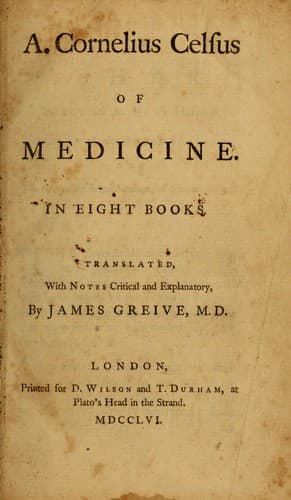
Of Medicine, in Eight BooksCelsus, Aulus Cornelius
History
Of Medicine, in Eight Books
Celsus, Aulus Cornelius
Medicine, Greek and Roman
It has been a question much debated, whether, and how far the writings
of the ancient physicians are of service to direct our practice in
the cure of diseases; but without repeating what has been already
said on this point, I imagine their usefulness may be inferred from
this single consideration, that the mechanism of the human body being
always and every where the same, a faithful history of diseases must
necessarily be one of the surest guides to the application of proper
remedies. Moreover, if the diagnostics and prognostics be of the
greatest moment in physic, and are only to be collected from long and
accurate observation, then the records left us by the ancients, who
were so assiduous in their observations, so clear and exact in their
descriptions, must be allowed to contain a valuable treasure of medical
knowledge.
We have seen, in the present age, many learned physicians, who, though
they readily admit the improvements of the moderns, nevertheless apply
themselves with great industry to the study of the ancients; and
indeed, to say nothing of the superiority of some of the ancients in
stile and composition, as a matter of taste, I think it can hardly
be denied, that a man, capable of making proper allowances for the
variations in respect of climate and manner of living, may receive
great benefit from the materials left us by these ingenious writers
of antiquity, and find many hints, which, pursued with diligence, and
applied with caution, may both correct and enlarge his practice.
Celsus is justly esteemed one of the most valuable amongst the
ancients. He is so often quoted, with approbation, by our best writers
in physic, and so much admired by the learned world for propriety,
ease, and elegance, that it is a needless attempt in these days to draw
his character. However, he is so little mentioned by the ancients, that
our curiosity cannot be gratified with any particulars of his life; nor
can we even determine what was his profession, if it does not appear
from his writings.
Quintilian often mentions a treatise of his upon rhetoric, which though
he hardly ever quotes, but where he differs from him, he allows to be
composed with accuracy. But whatever he thought of his oratory, he
gives an honourable testimony to the extent of his learning. For to
persuade his student of eloquence to make himself master of all the
sciences, after mentioning the greatest geniuses that ever appeared in
Greece or Rome, as Homer, Plato, Aristotle, Cato the censor, Varro,
and Cicero, he adds, “Why should I name any more instances? when even
Cornelius Celsus, a man of a moderate share of genius, has not only
composed treatises on all these arts, but has also left precepts of
the military art, agriculture, and medicine. The bare attempt requires
us to believe he understood all these subjects: but to give perfection
to so great a work is a difficult task, to which no man was ever found
equal[A].”
[A] Fab. Quintilian, lib. xii. c. 11.
Public-domain text, read in full here on John Shaqi.
Reviews
Reviews
No reviews yet
Be the first to share your thoughts on this work.
Join the Discussion
Join the discussion
Sign in to leave a comment or review.
Sign InorCreate an account