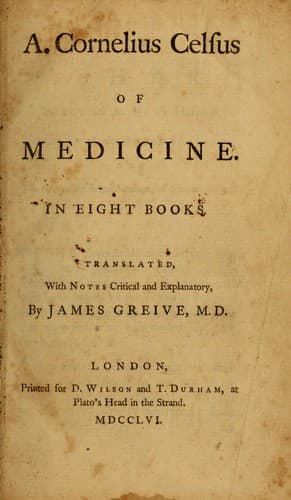
Of Medicine, in Eight BooksCelsus, Aulus Cornelius
History
Of Medicine, in Eight Books
Celsus, Aulus Cornelius
Medicine, Greek and Roman
It is dangerous for a wound to swell too much: not to swell at all is
extremely dangerous. The first is a sign of a violent inflammation;
the other of a mortification. If the patient be sensible, and no fever
has come on, we may at once conclude, that the wound will be soon
healed: and even a fever ought not to alarm us, if in a large wound it
continue, while the inflammation subsists; it is bad, when it either
supervenes to a slight wound, or lasts longer than the inflammation,
or brings on a delirium; or if it does not remove a tetanus, or
convulsion, that arose from the wound. Also an involuntary bilious
vomiting coming on either immediately after the wound is received,
or while the inflammation continues, is a bad symptom in those only,
whose nerves, or nervous parts are wounded. However to take a vomit is
not hurtful; especially in those, who have been accustomed to it; but
neither immediately after meat, nor when the inflammation has begun,
nor when the wound is in the superior parts.
[Sidenote: _Dressings for wounds._]
The wound being kept thus for two days, on third it must be opened,
and the sanies must be wiped off with cold water, and the same kind
of dressings put on. On the fifth day it will be easy to judge to
what height the inflammation is to rise. On which day the wound must
be uncovered again, and its colour observed. And if it be livid, or
pale, or variegated, or black, we may be sure it is a bad wound: and
whensoever this appearance is observed, it may alarm us. It is best for
a wound to be white, or ruddy. Also a hard, thick, and painful skin
denotes danger. It is a good sign, when this is free from pain, thin
and soft. But if the wound is closed, or there be a slight swelling,
the same application must be used as at first.
If the inflammation is violent, with no hopes of an agglutination,
and does not yield, the use of warm water too is necessary, that it
may dissipate the matter, and soften the hardness, and promote a
suppuration. It must be of such a degree of warmth, as to be agreeable
to the hand; and be continued so long, till it appear to have
diminished in some measure the swelling, and restored a more natural
heat to the ulcer. After this fomentation, if the wound does not gape
much, a plaister should be applied immediately, and if it be a large
wound, the tetrapharmacum would be best; in the joints, fingers, or
cartilaginous parts, the rhypodes. But if it gapes pretty much, that
same plaister must be softened with ointment of iris, and lint spread
with it must be laid over the wound; then the plaister applied above,
and over that sordid wool; and the rollers must be also less tight than
at first.
[Sidenote: _Peculiar directions for wounds in the joints._]
Public-domain text, read in full here on John Shaqi.
Reviews
Reviews
No reviews yet
Be the first to share your thoughts on this work.
Elsewhere in the archive
Join the Discussion
Join the discussion
Sign in to leave a comment or review.
Sign InorCreate an account