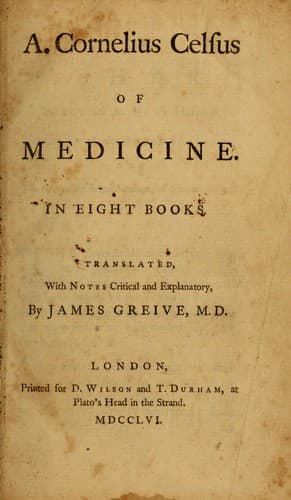
Of Medicine, in Eight BooksCelsus, Aulus Cornelius
History
Of Medicine, in Eight Books
Celsus, Aulus Cornelius
Medicine, Greek and Roman
A splinter, if possible, must be extracted either by the hand or
by an instrument: if it has either broke or penetrated deeper than
to admit of this, it must be drawn out by a medicine. Now the best
application for that purpose is the root of a reed; which if tender,
must be immediately bruised; if grown hard, it may be first boiled in
mulse: to this honey must always be added; or birthwort with honey must
be applied. The worst splinter is that of a reed, on account of its
asperity: the fern is also equally hurtful: but it has been found by
experience, that each of these bruised and applied is a cure for the
other. Every medicine, that has the faculty of drawing, has the same
effect in all splinters. The same kind of medicine is also finest for
deep and small wounds: the plaister of Philocrates is best adapted to
the former, that of Hecatæus to the latter case.
[Sidenote: _Of cicatrizing ulcers._]
In any wound, when we are to form the cicatrix (which is necessary
after the ulcers are thoroughly cleansed and incarned) in the first
place lint dipped in cold water must be applied, while the growth of
flesh is encouraged; afterwards when that is to be restrained, it
must be put on dry, till a cicatrix be formed; then white lead ought
to be bound over it, which both compresses the cicatrix, and gives
it a colour resembling the sound part of the body. The root of wild
cucumber has the same effect. Also the composition, which contains of
elaterium p. i. *. litharge p. ii. *. myrobalans p. iv. *. to which is
added turpentine resin, till the whole be brought to the consistence
of a plaister. But black cicatrices are gently cleansed by a mixture
of equal parts of verdigrease, and washed lead, and the same resin
boiled, whether the cicatrix be anointed with this, which may be
practised in the face, or it be applied like a plaister, which is more
convenient in other parts of the body.
But if the cicatrix is either protuberant or hollow, it is ridiculous,
merely in regard to the appearance to submit a second time to the pain
and trouble of a cure; otherwise both cases might be remedied. For
either of these cicatrices may be converted into a wound by the knife.
If one rather chuses a medicine, the same purpose is answered by those
compositions, which eat down flesh. When the skin is taken off, upon
the prominent one must be applied eating medicines, upon the hollow one
such as tend to fill up, till both these kinds of ulcers be brought to
the level of the sound skin, and then they may be cicatrized.
CHAP. XXVII.
OF WOUNDS CAUSED BY BITES; POISONS TAKEN INTERNALLY; AND BURNS.
I have treated of those wounds, which are most commonly inflicted
by weapons. It follows, that I speak concerning those, which are
occasioned by the bite, sometimes of a man, sometimes of an ape, often
of a dog, sometimes of wild beasts, or other animals, or serpents. Now
almost all bites(70) are in some degree venomous.
Public-domain text, read in full here on John Shaqi.
Reviews
Reviews
No reviews yet
Be the first to share your thoughts on this work.
Elsewhere in the archive
Join the Discussion
Join the discussion
Sign in to leave a comment or review.
Sign InorCreate an account