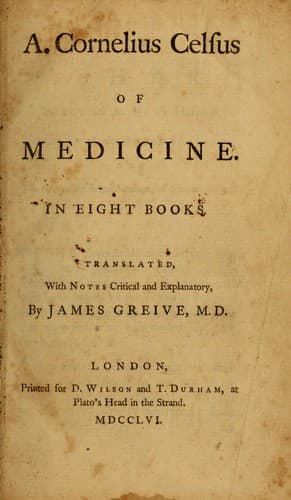
Of Medicine, in Eight BooksCelsus, Aulus Cornelius
History
Of Medicine, in Eight Books
Celsus, Aulus Cornelius
Medicine, Greek and Roman
Pustules break out chiefly in the spring season. Of these there are
several kinds. For sometimes there is a certain asperity over the whole
body, or a part, resembling those pustules, which are occasioned by a
nettle, or from sweat; the Greeks call them exanthemata[FI]. And they
are sometimes red, at other times of the same colour with the skin.
Sometimes a great many grow resembling vari, sometimes larger. The
pustules are livid or pale, or black, or otherwise different from the
natural colour; and there is a humour contained in them. When they are
broke, the flesh below appears as it were ulcerated. By the Greeks they
are called phlyctænæ helcodes[FJ]. They arise either from cold, or from
fire, or from medicines.
[FI] ἐξανθήματα.
[FJ] φλύκταιναι ἑλκώδεις.
The phlyzacium[FK] is a pustule somewhat harder, of a whitish colour,
and sharp pointed. What is squeezed from it is moist. The pustules
sometimes turn to small ulcers, either dry or moist; and sometimes
attended only with an itching, at other times with an inflammation
and pain: pus or sanies issues from them, or both. And this occurs
in children chiefly; seldom in the trunk of the body; often in the
extremities.
[FK] φλυζάκιον.
The worst kind of pustule is that, which is called epinyctis[FL]. Its
colour either inclines to livid, or is a dark brown, or white. There
is a violent inflammation round it; and when it is opened, a mucous
ulceration is found within, in colour resembling its humour. The pain
of this is greater than in proportion to its bulk; for it is not
larger than a bean. And this likewise grows in the extremities, and
generally in the night-time: whence the Greeks have given it the name
of epinyctis.
[FL] ἐπινυκτὶς.
Now in the cure of all pustules, the first thing is to walk much, and
to take exercise: if that cannot be complied with, to use gestation.
The second rule is, to lessen the quantity of food; to abstain from
every thing acrid and extenuating. And nurses ought to observe the
same rules, if their sucking child is thus affected. Besides these,
one, that can bear it, if the pustules be small, ought to sweat in
the bagnio; and at the same time to sprinkle nitre over them; and
to anoint the part with a mixture of wine and oil; then to go into
the bath. If no benefit accrues from these, or if the pustules be of
a larger kind, a lentil must be applied, and when the surface of the
skin is taken off, we must have recourse to lenient medicines. After
the lentil, the epinyctis is to be treated with blood-herb, or green
coriander.
Public-domain text, read in full here on John Shaqi.
Reviews
Reviews
No reviews yet
Be the first to share your thoughts on this work.
Elsewhere in the archive
Join the Discussion
Join the discussion
Sign in to leave a comment or review.
Sign InorCreate an account