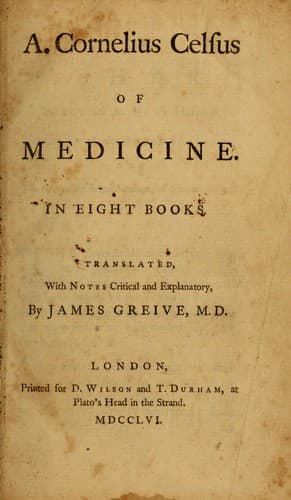
Of Medicine, in Eight BooksCelsus, Aulus Cornelius
History
Of Medicine, in Eight Books
Celsus, Aulus Cornelius
Medicine, Greek and Roman
An ephelis is cured by resin, with the addition of a third part of
fossile salt and a little honey. And for all these disorders, and
likewise for giving a proper colour to cicatrices, that composition
is good, which is said to be invented by Tryphon the father. In it
there are equal parts of myrobalans crocomagma, the bluish Cimolian
chalk(92), bitter almonds, flour of barley, and vetches, white
struthium, seed of mellilot: all these are powdered and brought to
a consistence with the bitterest honey, and being rubbed on in the
evening, are always washed off in the morning.
CHAP. VI.
OF THE DISORDERS OF THE EYES.
The foregoing are indispositions of small account. But our eyes are
exposed to grievous and various maladies. And because they contribute
so large a share both to the conveniency and pleasure of life, they
deserve our utmost care to preserve them.
Presently after the appearance of a lippitude, there are certain
indications, from which we may form a presage of the event. For, if
a discharge of tears, and a tumour, and a thick gum too(2) have
commenced at once; if that gum is mixed with tears, and the tears are
not hot, also if the gum is white and soft, and the tumour not hard,
there is no danger of the disorder continuing long. But if the tears
are copious, and hot, the gum little in quantity, the tumour small, and
these are confined to one eye; the case will prove tedious, but without
danger. And this species of lippitude is not at all painful; but is
hardly ever removed before the twentieth day; sometimes it continues
for two months, and sometimes not so long.
If the gum begins to be white and soft, and is mixed with tears, or
both these have attacked the two eyes at once; the lippitude may be
of shorter continuance, but there is a danger of ulcers. Now a dry
and parched gum occasions pain, but terminates sooner; unless it have
produced some ulcer.
A large tumour, if it be without pain, and dry, is void of all danger;
if it be dry, but attended with pain, it commonly ulcerates; and
sometimes, from this case it happens, that the eye-lid is agglutinated
to the eye. There is room also to fear an ulceration in the eye-lids or
the pupil, when besides great pain, there is a discharge of salt and
hot tears; or even when after the tumour is removed, the tears flow for
a long time mixed with the gum.
It is worse still, where the gum is pale or livid, the tears are
scalding, or in great quantity, the head hot, and the pain reaches
from the temples to the eyes, also if the person is distressed with
wakefulness in the night; for in such circumstances, generally the eye
bursts, when it were to be wished, it would only ulcerate. A slight
fever is of service to an eye that bursts inwardly. If it breaks and
is protruded externally, the case admits of no remedy. If from a black
colour, some part of it has become whitish, it continues long. But if
it be rough and thick, even after the cure, it leaves some mark.
Public-domain text, read in full here on John Shaqi.
Reviews
Reviews
No reviews yet
Be the first to share your thoughts on this work.
Elsewhere in the archive
Join the Discussion
Join the discussion
Sign in to leave a comment or review.
Sign InorCreate an account