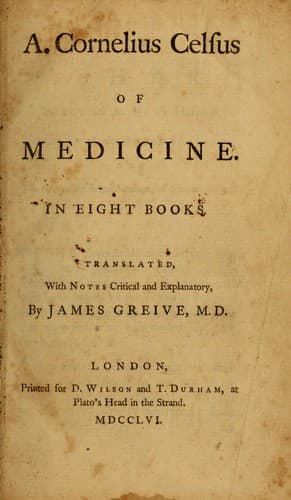
Of Medicine, in Eight BooksCelsus, Aulus Cornelius
History
Of Medicine, in Eight Books
Celsus, Aulus Cornelius
Medicine, Greek and Roman
Nevertheless, it sometimes happens, from some unfavourable circumstance
either in the weather, or habit of the patient, that for several days
neither the pain, nor the inflammation, and least of all, the discharge
of gum ceases. When this is the case, and time itself has brought
the disorder to a full maturity for it, relief is to be sought from
the same remedies, that is, the bath and wine. For though they are
hurtful, while these complaints are recent, because they may irritate
and inflame them; yet in the inveterate, which have not yielded to any
other remedies, they are commonly very efficacious. For in this, as
well as in other cases, when seemingly proper medicines have been tried
in vain, those of a contrary nature give relief. But it is expedient
for the patient, in the first place, to have his hair clipped close
to the skin; next, to foment his head and eyes in the bath, very
plentifully, with warm water; then to wipe both with a penecillum, and
anoint his head with ointment of iris; to lie in bed, till all the
heat acquired in the bath is gone off, and the sweat cease, which was
necessarily collected in his head. Then he should make use of the same
kind of food and wine above recommended, the latter undiluted; and
cover his head, and continue at rest. For after these, either a sound
sleep, or a sweat, or a purging, often puts an end to the discharge
of gum. If the disorder abates (which sometimes does not happen soon)
the same course ought to be pursued for several days, till the cure
be completed. If, on these days, he has no stool, a clyster must be
injected for relieving the superior parts.
But sometimes a great inflammation arises, and of so violent a nature,
that it propels the eyes from their cavity. The Greeks call this
proptosis[FX], because the eyes fall forward. It is plain such patients
require bleeding, if their strength will admit of it: if that cannot be
done, a clyster is necessary, and long fasting. The mildest medicines
are required _in this case_. Therefore, some use the first of Cleon’s
two collyriums mentioned above. But that of Nileus is the best, and all
authors agree to give it the preference to any other.
[FX] πρόπτωσις.
[Sidenote: _Nileus’s collyrium._]
Public-domain text, read in full here on John Shaqi.
Reviews
Reviews
No reviews yet
Be the first to share your thoughts on this work.
Elsewhere in the archive
Join the Discussion
Join the discussion
Sign in to leave a comment or review.
Sign InorCreate an account