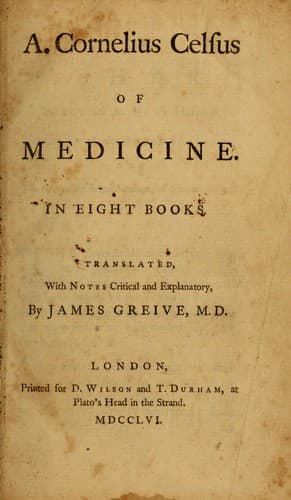
Of Medicine, in Eight BooksCelsus, Aulus Cornelius
History
Of Medicine, in Eight Books
Celsus, Aulus Cornelius
Medicine, Greek and Roman
But when compound medicines are not to be had, both honey and wine
mitigates an asperity in the angles. These and a dry lippitude too are
relieved by an application of bread, softened with wine, over the eyes.
For since there is generally a humour, which exasperates sometimes the
eye itself, sometimes the angles, or eyelids; by this application, if
any humour is discharged, it is drawn away, and if it happens to be
lodged near, is repelled.
[Sidenote: _Of a dimness of the eyes._]
A dimness comes upon the eyes, sometimes from a lippitude, at other
times even without that, from old age, or weakness. If the disorder
proceeds from the relics of a lippitude, the collyrium called asclepias
is serviceable. Likewise that, which is composed of crocomagma.
The collyrium which is called diacrocou[GD] is composed peculiarly for
this. It contains of pepper p. i. *. Cilician saffron, poppy tears,
ceruss, each p. ii. *. psoricum, gum, each p. iv. *.
[GD] διὰ κρόκου.
But if it arises from old age, or weakness, it may be proper to anoint
with the best honey, and cyprine and old oil. But it is most expedient
to mix together one part of balsam, and two of old, or cyprine oil,
and three parts of the most pungent honey. The medicines prescribed
above for a dimness _from a lippitude_, and those mentioned before for
diminishing cicatrices, are useful in this case too.
Whoever is troubled with a dimness must walk much, use exercise,
frequent bathing, at which time the whole body must be rubbed, but
principally the head, with iris ointment till it sweat; after that it
must be veiled, and not uncovered, till after he has got home, and
the sweat and heat have ceased. Then he must keep to an acrid and
extenuating diet; and after the interval of some days use a gargarism
of mustard.
[Sidenote: _Of a cataract._]
A suffusion also, which the Greeks call hypochysis[GE], sometimes
obstructs the pupil of the eye, where vision is performed. If this
disorder be inveterate, it requires an operation to remove it. At the
beginning sometimes it is discussed by certain methods adapted to the
case. It is expedient to bleed in the forehead, or nose; to cauterize
the veins in the temples; by the use of gargarisms to evacuate phlegm;
to use fumigations; to anoint the eyes with acrid medicines. The best
diet is such as extenuates phlegm.
[GE] ὑπόχυσις.
[Sidenote: _A palsy of the eyes._]
Nor is a palsy of the eyes (which the Greeks call paralysis) to be
cured by any different diet, or different medicines, so that it is
needless to do more than describe the distemper. It happens then
sometimes in one eye, sometimes in both, either from a blow, or from
an epilepsy, or spasms, where the eye itself is strongly convulsed, so
that it can neither be directed to any particular object, nor be kept
fixed; but moves to and fro involuntarily; and therefore cannot see any
thing distinctly.
[Sidenote: _Of a mydriasis._]
Public-domain text, read in full here on John Shaqi.
Reviews
Reviews
No reviews yet
Be the first to share your thoughts on this work.
Elsewhere in the archive
Join the Discussion
Join the discussion
Sign in to leave a comment or review.
Sign InorCreate an account