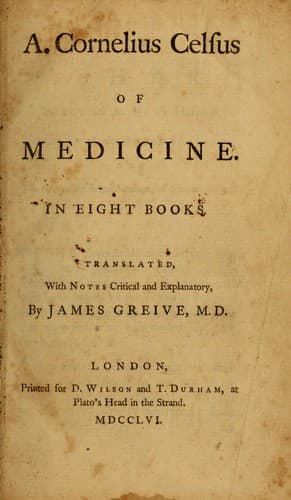
Of Medicine, in Eight BooksCelsus, Aulus Cornelius
History
Of Medicine, in Eight Books
Celsus, Aulus Cornelius
Medicine, Greek and Roman
What the Greeks call a mydriasis[GF] is not very different from this
distemper. The pupil is dilated, the sight grows dull, and almost dim.
This kind of weakness is extremely difficult to remove. Against both
disorders, that is, the palsy and mydriasis, we must use the same
remedies as have been prescribed in the dimness of the eyes, with a few
alterations; thus for the head, to the iris oil must be added sometimes
vinegar, sometimes nitre; it is sufficient to anoint the eyes with
honey. In the latter disorder some have made use of hot waters(8),
and been relieved; others without any apparent cause have suddenly lost
their sight. Some of these, after continuing blind for some time, from
a sudden purging have recovered their sight: whence it seems the less
improper, both when the disorder is recent, and when it is of some
standing, to procure stools by medicines, in order to force all the
noxious matter into the lower parts.
[GF] μυδρίασις.
[Sidenote: _A weakness of the eyes._]
Besides these, there is a kind of weakness of the eyes, in which
patients see well enough in the day-time, but not at all in the night:
which never happens to a woman, when her menstrual discharge is
regular. But persons labouring under this disorder ought to be anointed
with the blood of a liver (particularly the liver of a he-goat; if
that cannot be had, of a she-goat) that drops from it while roasting;
and they ought to eat the liver itself. They may nevertheless not
improperly make use of the same medicines, that extenuate either
cicatrices, or an asperity. Some powder the seed of purslane, and add
honey to it, till the mixture be of such a consistence, as not to
drop off a probe, and anoint with that. They must also use exercises,
bathing, frictions.
[Sidenote: _Of external hurts in the eyes._]
These disorders all arise from internal causes. But externally the eye
may be hurt by a blow, so as to become bloodshot. There is nothing
more proper for this case than anointing with the blood of a pigeon,
or ringdove, or swallow. Nor is this practice without reason; since
the sight of these birds being hurt by some accident, in a little time
is restored, and that of the swallow soonest; which gave rise to the
fable, that their parents perform by an herb the cure, which is really
the work of nature. Their blood therefore is a very proper remedy for
our eyes in external hurts, in these different degrees of efficacy;
the blood of a swallow is best, next to that of a ringdove; that of a
pigeon is least medicinal both to itself and us.
Public-domain text, read in full here on John Shaqi.
Reviews
Reviews
No reviews yet
Be the first to share your thoughts on this work.
Elsewhere in the archive
Join the Discussion
Join the discussion
Sign in to leave a comment or review.
Sign InorCreate an account