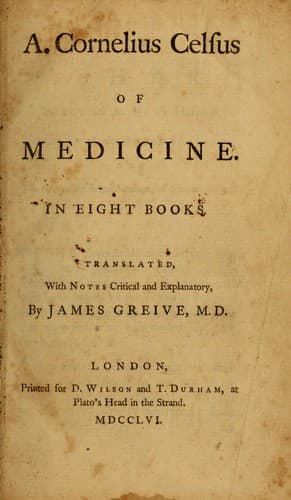
Of Medicine, in Eight BooksCelsus, Aulus Cornelius
History
Of Medicine, in Eight Books
Celsus, Aulus Cornelius
Medicine, Greek and Roman
That surgery makes the third part of medicine, is both universally
known, and has been already observed. This does not indeed discard
medicines, and a proper regimen; but yet the principal part is
accomplished by the hand. And the effect of this is the most evident
of all the parts of medicine. For as fortune contributes a good deal
to the cure of distempers, and the same things are often salutary,
often fruitless; it may be doubted, whether the recovery be owing
to physic, or the constitution. In those diseases also, in which
we chiefly make use of medicines, although their success be pretty
evident, nevertheless it is plain, that health is both sought for
by their means in vain, and often restored without them. As may be
observed with regard to the eyes, which after having long suffered from
the applications of physicians, sometimes recover of themselves. But
in surgery it is manifest that the success, though it may be somewhat
promoted by other means, is chiefly to be ascribed to this. Now this
branch, though it be the most ancient, yet has been more cultivated
by Hippocrates the father of all medicine, than by his predecessors.
Afterwards being separated from the other parts, it began to have its
peculiar professors, and received considerable improvements in Egypt,
as well as elsewhere, principally from Philoxenus, who has treated of
this part fully, and with great accuracy, in several volumes. Gorgias
also, and Sostratus, the two Herons, and the two Apollonii, and
Ammonius Alexandrinus, and many other celebrated men, have each of them
made some discoveries. And at Rome too professors of no small note,
and particularly of late Tryphon the father, and Euelpistus the son of
Phleges, and Meges the most learned of them all, as appears from his
writings, by altering some things for the better have made considerable
additions to this art.
A surgeon ought to be young, or at most but middle aged, to have a
strong and steady hand, never subject to tremble, and be no less
dexterous with his left than his right hand; to have a quick and clear
sight; to be bold, and so far void of pity, that he may have only in
view the cure of him, whom he has taken in hand, and not in compassion
to cries either make more haste than the case requires, or his cut less
than is necessary; but to do all, as if he was not moved by the shrieks
of his patient.
Public-domain text, read in full here on John Shaqi.
Reviews
Reviews
No reviews yet
Be the first to share your thoughts on this work.
Elsewhere in the archive
Join the Discussion
Join the discussion
Sign in to leave a comment or review.
Sign InorCreate an account