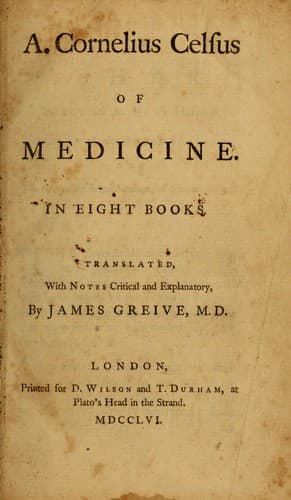
Of Medicine, in Eight BooksCelsus, Aulus Cornelius
History
Of Medicine, in Eight Books
Celsus, Aulus Cornelius
Medicine, Greek and Roman
But the followers of Themison, if they assert their maxims to hold
universally, are still more rationalists than those, that pass under
that name; for though one rationalist does not maintain all that
another approves, there is no necessity to invent a new appellation
for him; provided, which is the principal thing, he does not proceed
upon memory alone, but takes in reason too. But if, which is nearer
to the truth, the art of medicine hardly admits of any universal
precepts, then they are in the same class with those, who depend upon
experiments alone: and the more so, because any unskilful person can
discover, whether a distemper has bound up a man, or rendered him
lax. Now if what relaxes a constringed body, or restrains a loose, be
drawn from reason, such a practitioner is a rational physician: but if
from experience, as he must confess, who will not allow himself to be
a rationalist, then he is an empirick. And so, according to him, the
knowledge of the distemper is foreign to the art, but the remedy lies
within the bounds of experience. Nor is any improvement made by them
upon the profession of the empiricks, but on the contrary, something
is taken from it; the empiricks attending with great circumspection to
many circumstances; whereas these regard only the easiest, and no more
than the common things. For in like manner those, who are employed in
curing cattle, since it is impossible for them to be informed by the
dumb animals, what is peculiar in the case of each, regard only what
is common to them all: and foreign nations, as they are not acquainted
with any subtile theory of medicine, take notice only of the common
symptoms: those also, who take under their care a great number of
patients, because they are not able to consult the distinct necessities
of each with the utmost attention, have respect only to those generals.
Nor indeed were the ancient physicians ignorant of this method, but
they were not content with it; for even the most ancient writer
Hippocrates said, that in practice it is necessary to regard both the
general and peculiar circumstances. Nor is it possible even for them to
confine themselves within the narrow limits of their own profession;
for there are different kinds both of the bound, and lax disorders;
which is more easily observed in the lax, for it is one thing to vomit
blood, another to vomit bile, and another to vomit the food: and
there is also a difference betwixt labouring under a simple purging,
and a dysentery; between being weakened by sweats, and wasted by a
consumption. A humour also breaks out upon particular parts, as the
eyes, for instance, and the ears; and no member of the human body is
free from that danger. Now not one of these disorders is cured exactly
in the same manner as another; so that in these, medicine descends from
the general observation of the lax kind, to the peculiar. And in this
again another kind of knowledge of peculiarity is often necessary;
Public-domain text, read in full here on John Shaqi.
Reviews
Reviews
No reviews yet
Be the first to share your thoughts on this work.
Join the Discussion
Join the discussion
Sign in to leave a comment or review.
Sign InorCreate an account