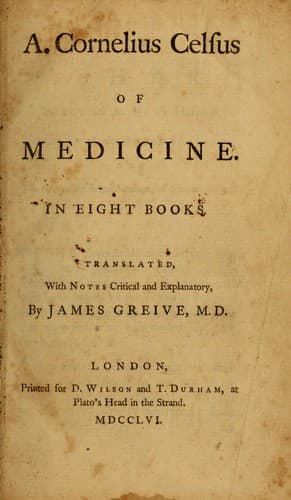
Of Medicine, in Eight BooksCelsus, Aulus Cornelius
History
Of Medicine, in Eight Books
Celsus, Aulus Cornelius
Medicine, Greek and Roman
To return to my point then, my opinion is, that
medicine ought to be rational, but to draw its methods from the evident
causes, all the obscure being removed, not from the attention of the
artist, but from the practice of the art. Again, to dissect the bodies
of living men is both cruel and superfluous. But the dissection of dead
subjects is necessary for learners: for they ought to know the position
and order of the parts, which dead bodies will show better, than a
living and wounded man. But as for the other things, which can only be
observed in living bodies, practice itself will discover them in the
cure of the wounded, somewhat more slowly, but with more tenderness.
Having delivered my sentiments upon these points, I shall lay down the
proper rules for the management of people in health, and then proceed
to what relates to diseases and their cure.
CHAP. I.
RULES FOR THE HEALTHY.
A sound man, who is both in health, and his own master, ought to
confine himself to no rules; and neither call for the assistance of a
physician nor an iatroalipta(16). ’Tis good for him to diversify his
way of life; to be sometimes in the country, sometimes in the city,
and frequently in the fields; to sail, to hunt; sometimes to rest,
but exercise himself frequently: for indolence enervates the body,
labour strengthens it: the first brings on a quick old age, the other
makes a long youth. ’Tis also proper to make use sometimes of the
warm bath(17), and sometimes of the cold; to anoint sometimes, and
at other times to neglect it; to avoid no kind of food, that may be
in common use; sometimes to eat in company, at other times to retire
from it; sometimes to eat more than is sufficient, and at other times
no more; to take food rather twice in the day than once; and always
as much as he can, provided he concoct it. But as exercise and food
of this kind are necessary, so the exercise and diet of wrestlers are
inconvenient: both because the order of exercise being interrupted by
some necessary business of life, hurts the body; and because those
bodies, which are very high fed, like their’s, soonest decay, and are
most liable to diseases.
[Sidenote: _Of Coition._]
Coition is neither to be too much desired, nor too much feared. Seldom
used, it excites the body; frequent, relaxes. But as the frequency
is to be judged of, not by the number of repetitions, but by nature,
regard being had to the age and constitution, we may know it not to
be useless, when it is neither followed by a languor of the body, nor
pain. It is worse in the day-time, but safer in the night; _but the
general rule will hold for both_, if neither meat be taken after the
first, nor the other be followed by wakefulness and labour. These
things are to be observed by strong people; and care must be taken,
that the reliefs of sickness be not wasted in good health.
CHAP. II.
RULES FOR VALETUDINARY PEOPLE.
Public-domain text, read in full here on John Shaqi.
Reviews
Reviews
No reviews yet
Be the first to share your thoughts on this work.
Join the Discussion
Join the discussion
Sign in to leave a comment or review.
Sign InorCreate an account