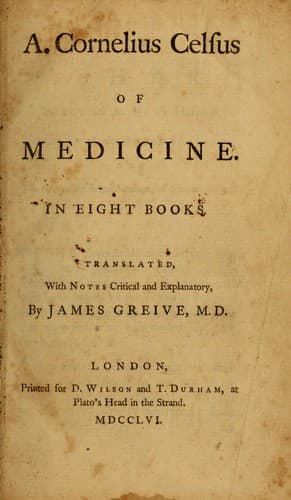
Of Medicine, in Eight BooksCelsus, Aulus Cornelius
History
Of Medicine, in Eight Books
Celsus, Aulus Cornelius
Medicine, Greek and Roman
Before an illness, as I mentioned above, there appear some signs of
its approach. All of them have this in common, that the body alters
from its ordinary state; and not only for the worse, but even for
the better. For this reason, if one has become more plump, and looks
better, and of a more florid complexion than usual, he ought to hold
these advantages suspected. For because these things can neither
continue at a stay, nor admit further improvement, they generally run
backward very fast, like some heavy body tumbling down. But it is a
worse sign, when one is emaciated contrary to his natural habit, and
has lost his colour and comeliness: because bodies redundant can allow
something to be carried off by a distemper; the deficient have not
wherewithal to bear the force of the distemper itself. Besides there
is cause to be presently alarmed, if the limbs are heavy; if frequent
ulcers break out; if the body has grown hotter than common; if sleep
be too heavy; if the dreams are tumultuous; if one awakes oftner than
usual, and then falls asleep again; if the body of a person asleep
sweats in some parts contrary to custom, especially if that be about
the breast, or neck, or legs, or knees, or hips; also if the mind is
languid; if there is a reluctance to speaking and motion; if the body
be indisposed to action; if the præcordia are pained, or the whole
breast, or which happens in most people, the head; if the mouth is
filled with saliva; if the eyes feel pain in turning; if the temples
be strait bound(5): if the limbs have shudderings; if the breathing
is difficult; if the arteries in the forehead are dilated and beat
strong; if there be frequent yawnings; if the knees feel tired, or
the whole body be afflicted with a lassitude. Several of these things
often, some of them always, precede a fever. This, however, ought to
be first considered, whether any of these happen frequently to a person
without any consequent uneasiness. For there are some peculiarities
in the constitutions of particular persons, without the knowledge of
which, it is not easy to prognosticate what is to happen. With reason
therefore a man is free from apprehensions about those things, which
he has often escaped without danger: he only is justly uneasy, to whom
these appearances are new, or who has never been secured from their bad
effects without proper precautions.
CHAP. III.
GOOD SYMPTOMS IN SICK PEOPLE.
Public-domain text, read in full here on John Shaqi.
Reviews
Reviews
No reviews yet
Be the first to share your thoughts on this work.
Elsewhere in the archive
Join the Discussion
Join the discussion
Sign in to leave a comment or review.
Sign InorCreate an account