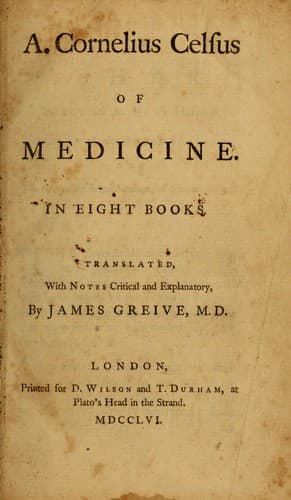
Of Medicine, in Eight BooksCelsus, Aulus Cornelius
History
Of Medicine, in Eight Books
Celsus, Aulus Cornelius
Medicine, Greek and Roman
if it be green, or black, it is worse. Urine is bad, where the sediment
is reddish or livid; and worse, in which there is a kind of small and
white threads: and worst of all, that, which bears the resemblance of
small clouds, composed as it were of particles of bran. Thin and white
urine is bad, but especially in phrenitic patients. It is bad to have
the belly entirely bound. And a purging too in fevers is dangerous,
where it will not allow a man to rest in his bed; especially if the
discharge be very liquid, or whitish, or pale, or frothy. Besides these
it portends danger, if the excretion be small in quantity, glutinous,
smooth, white, and at the same time of a palish colour; or if it is
either livid, or bilious, or bloody, or of a more offensive smell than
common. An unmixed discharge also, which comes after long fevers, is
bad.
CHAP. V.
SIGNS OF LONG SICKNESS.
After the foregoing symptoms have appeared, ’tis known, that a
distemper will become tedious: for it must necessarily be so, unless it
be mortal. And there is no other hope in violent diseases, than that
the patient may escape by eluding the first shock of the distemper,
that there may be room for the application of proper methods of cure.
But some signs appear in the beginning of a distemper, from which we
may gather, that although it does not prove mortal, yet it will last
for a considerable time. In fevers not violent, when a cold sweat comes
on only about the head or neck; or when the body sweats without the
fever intermitting; or when the body is sometimes cold, and sometimes
hot, and the colour changes; or when in fevers an abscess, which has
been formed in some part, does not prove salutary; or when the patient,
considering the time of his illness, is but little emaciated. Also, if
the urine at some times is thin and limpid, and at other times has some
sediment; and if what subsides be smooth, and white, or red; or if it
have the appearance of motes; or if it send up air bubbles.
CHAP. VI.
THE SYMPTOMS OF DEATH.
Public-domain text, read in full here on John Shaqi.
Reviews
Reviews
No reviews yet
Be the first to share your thoughts on this work.
Elsewhere in the archive
Join the Discussion
Join the discussion
Sign in to leave a comment or review.
Sign InorCreate an account