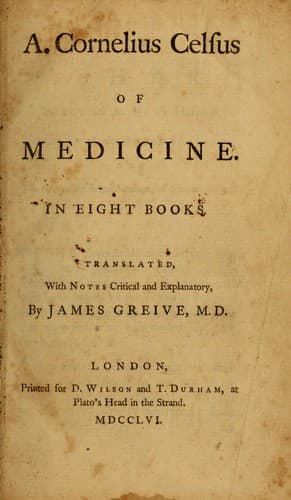
Of Medicine, in Eight BooksCelsus, Aulus Cornelius
History
Of Medicine, in Eight Books
Celsus, Aulus Cornelius
Medicine, Greek and Roman
But though in such circumstances there is reason to fear, yet there
remains some hope. But we are sure a person is come to the last stage,
when the nose is sharp, the temples shrivelled, the eyes hollow, the
ears cold, and languid, and slightly inverted at their extremities,
the skin about the forehead hard and tense, the colour either black
or very pale; and much more so, if these things happen without any
preceding wakefulness, or purging, or fasting: from which causes this
appearance sometimes arises, but then it vanishes in one day. So that
if it continues longer, it is a forerunner of death. And if it remains
the same for three days in a tedious distemper, death is very near:
and more especially if besides the eyes can’t bear the light and shed
tears; and the white part of them grows red; and their small vessels
are pale; and humour floating in them at last sticks to the angles; and
one eye is less than the other; and they are either very much sunk,
or much swelled; and when the eye-lids in sleep are not closed, but
betwixt them there appears some part of the white of the eye; provided
it be not occasioned by a flux; when the eye-lids also are pale, and
the same paleness discolours the lips and nose; and also when the lips,
and nose, and eyes, and eye-lids, and eye-brows, or some of these, are
distorted, and the patient from pure weakness loses his hearing, or
sight.
Death is also to be expected, when the patient lies supine, and his
knees are contracted; when he slides downward now and then towards
his feet; when he lays bare his arms and legs, and tosses them about
irregularly, and there is no heat in them; when he gapes with his
mouth; when he sleeps constantly; when being insensible, he grinds
his teeth, and had not that custom in health; when an ulcer, which
broke out either before, or in the time of his sickness, has grown
dry, and turned either pale or livid, The following symptoms are
also deadly; pale-coloured nails, and fingers; a cold breath; or if
one in a fever, and acute disease, or madness, or peripneumony, or
pain of the head, gathers the wool off the cloaths with his hands, or
draws out and smooths their edges, or catches at any small prominences
in an adjoining wall. Pains also, that have begun in the hips and
lower parts, if they have been translated to the bowels, and suddenly
ceased, are sure prognostics of approaching death; and more so, if any
of the other symptoms have also concurred. And it is impossible to
save that person, who labouring under a fever without any tumour, is
suddenly, _as it were_, strangled, or cannot swallow his spittle; or
one, whose neck, while the fever and habit of body remain the same,
is turned aside, so that it is equally impossible for him to swallow
any thing; or him, who at the same time has a continued fever, and
extreme weakness of body; or when, without an abatement of the fever,
the external surface of his body is cold, and the internal parts so
Public-domain text, read in full here on John Shaqi.
Reviews
Reviews
No reviews yet
Be the first to share your thoughts on this work.
Elsewhere in the archive
Join the Discussion
Join the discussion
Sign in to leave a comment or review.
Sign InorCreate an account