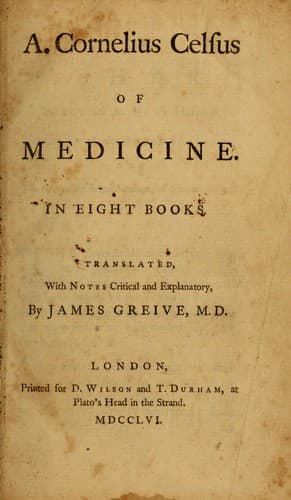
Of Medicine, in Eight BooksCelsus, Aulus Cornelius
History
Of Medicine, in Eight Books
Celsus, Aulus Cornelius
Medicine, Greek and Roman
If the disorder be in the whole body, the evacuation ought to be made
from the arm: if in any particular place, from the part affected, or
at least as near to it as may be; because it cannot be performed every
where, but only in the temples, and in the arms, and near the ancles. I
am not ignorant, that it is the opinion of some, that blood should be
let at the greatest distance from the part where it does harm; for that
thus the course of the matter is diverted; but in the other way it is
drawn into that very place, which is distressed. But this is altogether
false. For it first empties the part nearest: and the blood flows from
the more remote, as long as the evacuation is continued: when this is
stopt, because there is no more attraction, it then ceases to come.
Yet experience itself seems to have shewn, that in a fracture of the
skull blood is to be let rather from the arm: and if the disorder is
in one arm, it must be performed in the other: I suppose for this
reason, because if any miscarriage should happen, those parts, which
are already hurt(18), are more exposed to injuries. Sometimes also an
hæmorrhage breaking out in one part, is stopt by bleeding in another.
For it ceases to flow, where we would not have it, when we apply what
will stop its course there, and open another passage for it.
Altho’ bleeding is very easy to one, who has experience; yet it is very
difficult to one, that is ignorant. For the vein lies close to the
arteries; and to these the nerves. So that if the lancet has touched a
nerve, a convulsion will follow, which destroys a man miserably. And
then a wounded artery neither unites again, nor heals; and sometimes it
occasions a violent hæmorrhage. If also the vein itself happens to be
cut quite through, the two ends are compressed, and discharge no blood.
Again, if the lancet is entered with fear, it lacerates the surface
of the skin, and does not open the vein. Sometimes too the vein lies
concealed, and is not easily found. Thus many circumstances make that
difficult to an ignorant person, which is very easy to the skilful.
The vein is to be cut at the middle. And when the blood flows from it,
its colour and consistence ought to be observed. For if it be thick
and black, it is bad; and therefore the discharge is useful: if red
and pellucid, it is sound; and that evacuation is so far from being
beneficial, that it may even hurt, and is immediately to be stopt. But
such an accident cannot happen to the physician, who knows in what case
bleeding is to be used. It more commonly happens, that it flows on
the first day equally black thro’ the operation. And altho’ it be so,
yet if the discharge is sufficient, it must be stopt: and an end must
always be put to it, before the person faints.
Public-domain text, read in full here on John Shaqi.
Reviews
Reviews
No reviews yet
Be the first to share your thoughts on this work.
Elsewhere in the archive
Join the Discussion
Join the discussion
Sign in to leave a comment or review.
Sign InorCreate an account