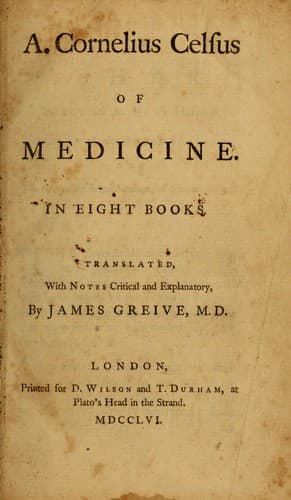
Of Medicine, in Eight BooksCelsus, Aulus Cornelius
History
Of Medicine, in Eight Books
Celsus, Aulus Cornelius
Medicine, Greek and Roman
Then the arm is to be bound up, putting upon it a penecillum(19)
dipt in cold water, and squeezed; and on the following day, the vein
must be rubbed with the middle finger, that its recent union may be
resolved, and it may again discharge blood. Whether it happens on the
first or second day, that the blood, which at first flowed thick, and
black, has begun to appear red and pellucid, there is then a sufficient
quantity taken away, and what remains is pure: so that the arm is to be
immediately bound up, and kept so, till the cicatrice is firm; which
firmness it very soon acquires in a vein.
CHAP. XI.
OF CUPPING.
There are two sorts of cucurbitals: the one of copper, the other of
horn. That of copper is open at the one end, and close at the other;
that of horn is likewise open at one end, and at the other has a small
hole. Into the copper one burning linen is put, and its mouth is clapt
close to the body, and is prest down, till it adhere to it. The horn
kind is only applied to the body, and after that, when a person has
sucked out the air by the small hole, and that is closed with wax, it
sticks, as well as the other. Both of these are made not only of these
two materials, but of any thing else. Where no better can be got, a
small cup with a narrow mouth is fit enough for the purpose. When it
adheres, if the skin has been cut before with a scalpel, it will bring
out blood: if the skin is whole, air. Wherefore when the offence is
from matter contained within, the first method is to be pursued: when
it is only a flatulency, the other is commonly used.
Now the principal use of a cucurbital is, when a disorder is not in the
whole body, but only in a part, the emptying of which is sufficient to
render it sound. And this very thing is a proof, that in the cure of
any member, bleeding by a lancet too is to be performed rather in the
part which is already hurt: because no body puts the cucurbital upon
a different part, unless to divert the flux of blood thither, but on
that, which is diseased, and which is to be relieved.
There may possibly be a necessity for using the cucurbital in chronic
distempers (although they be already of some standing) if there be
either corrupted matter, or a flatulency. Likewise in some acute
distempers, if at the same time the body requires to be lightened, and
the strength will not admit of bleeding from a vein. And this remedy,
as it is less violent, so it is more safe; and is never dangerous,
though it be made use of in the greatest violence of a fever, or even
in the time of crudity. For this reason, when there is a necessity for
bleeding, if the opening of a vein is very dangerous, or the disorder
is fix’d in a noble part of the body, we must also have recourse to
this instrument. We must be sensible however, that as it is attended
with no danger, so it gives a feebler aid; and that is not possible to
relieve a violent distemper, but by an equally violent remedy.
CHAP. XII.
OF PURGING.
Public-domain text, read in full here on John Shaqi.
Reviews
Reviews
No reviews yet
Be the first to share your thoughts on this work.
Elsewhere in the archive
Join the Discussion
Join the discussion
Sign in to leave a comment or review.
Sign InorCreate an account