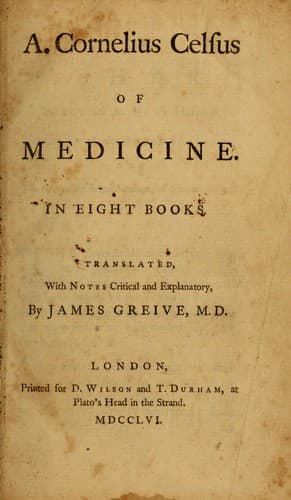
Of Medicine, in Eight BooksCelsus, Aulus Cornelius
History
Of Medicine, in Eight Books
Celsus, Aulus Cornelius
Medicine, Greek and Roman
Concerning friction(25), Asclepiades looking upon himself as the
inventor of it, has said so much in that book, which he entitled ‘of
general remedies,’ that tho’ he mentions only three things, that, and
wine, and gestation, yet he has taken up the greatest part of his
treatise upon the first. Now as it is not fit to defraud the moderns
of the merit either of their new discoveries or judicious imitations,
_so it is but just_ at the same time to assign those things, which were
practised among some of the ancients, to their true authors. It cannot
indeed be doubted, that Asclepiades has been both fuller and clearer
in his directions, when and how friction ought to be used; but he has
discovered nothing, which was not comprized in a few words by the
most ancient author Hippocrates; who said, that friction, if violent,
hardens the body; if gentle, softens it; if plentiful, extenuates; if
moderate, increases its bulk: from whence it follows, that it is to be
made use of, when a lax body requires to be braced; or to soften one,
that is indurated; or to dissipate where the fulness is hurtful; or to
nourish that, which is slender and infirm.
Nevertheless, if a person examine more curiously into these different
species (which is not here the province of a physician) he will easily
understand that the effects of them all proceed from one cause; that
is, the carrying off of something. For a part will be bound, when that
thing is taken away, the intervention of which had caused it to be
lax; and another is softened by removing that, which occasioned the
hardness; and the body is filled, not by the friction itself, but by
that food, which afterwards makes its way to the skin, relaxed by a
kind of digestion(26). And the degree of it is the cause of these
effects so widely different.
Public-domain text, read in full here on John Shaqi.
Reviews
Reviews
No reviews yet
Be the first to share your thoughts on this work.
Elsewhere in the archive
Join the Discussion
Join the discussion
Sign in to leave a comment or review.
Sign InorCreate an account