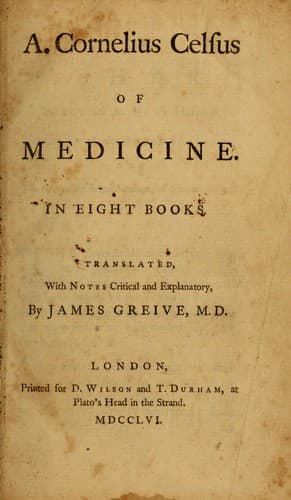
Of Medicine, in Eight BooksCelsus, Aulus Cornelius
History
Of Medicine, in Eight Books
Celsus, Aulus Cornelius
Medicine, Greek and Roman
Having already considered all that relates to distempers in general, I
come to treat of the cure of each distinctly. Now the Greeks divided
them into two kinds, the one they called acute, the other chronic. And
because their process was not always the same, for this reason some
ranged the same distempers among the acute, which others reckoned in
the number of the chronic. From whence it is plain, that there are more
kinds of them. For some are short and acute, which either carry off a
person quickly, or are themselves soon terminated. Others are of long
continuance, from which there is neither a speedy recovery, nor speedy
death. And the third kind are those, which are sometimes acute, and
sometimes chronic; and this happens not only in fevers, where it is
most frequent; but also in other diseases. And besides these, there is
a fourth kind; which can neither be called acute, because they are not
mortal; nor yet chronic, because if remedies are used, they are easily
cured. When I come to treat of each, I shall point out to what kind
they belong.
Now I shall divide all of them into those, that seem to affect the
whole body, and those, which occur in particular parts. After a few
general observations upon them all, I shall begin with the first.
Though there is no distemper in which fortune can pretend to more
power than art, or art than nature; since medicine can do nothing in
opposition to nature: yet a physician is more excusable for want of
success in acute, than in chronic disorders. For in the first, there is
but a small space, within which, if the remedies do not succeed, the
patient dies: in the other case, there is time both for deliberation,
and a change of medicines; so that very seldom, where a physician is
called at its beginning, an obedient patient is lost without his fault.
Nevertheless, a chronic distemper, when it is firmly rooted, becomes
equally difficult with an acute one. And indeed the older an acute
distemper is, so much the more easily it is cured; but a chronic one,
the more recent it is.
There is another thing we ought not to be ignorant of; that the
same remedies don’t agree with all patients. Whence it happens,
that the greatest authors extol some one remedy, some another, each
recommending his own as the only one, according as they had succeeded
with themselves. It is fit therefore, when any thing does not answer,
not to pay so much regard to the author of it, as to the patient, and
to make trial of one thing after another. _Remembering_ however, that
in acute distempers, what does not relieve, must be quickly changed:
in the chronic, which time both causes, and removes, whatever has not
immediately done service, is not to be hastily condemned; much less
must that be discontinued, which does but give a small relief, because
its good effects are completed by time.
CHAP. II.
Public-domain text, read in full here on John Shaqi.
Reviews
Reviews
No reviews yet
Be the first to share your thoughts on this work.
Elsewhere in the archive
Join the Discussion
Join the discussion
Sign in to leave a comment or review.
Sign InorCreate an account