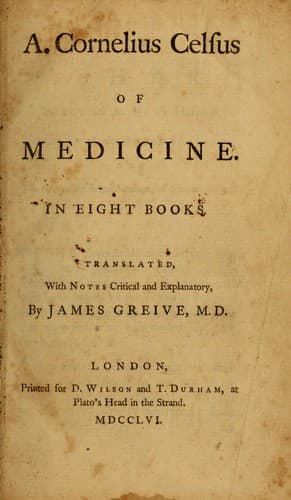
Of Medicine, in Eight BooksCelsus, Aulus Cornelius
History
Of Medicine, in Eight Books
Celsus, Aulus Cornelius
Medicine, Greek and Roman
GENERAL DIAGNOSTICS OF ACUTE AND CHRONIC, INCREASING AND DECLINING
DISEASES; THE DIFFERENCE OF REGIMEN IN EACH; AND PRECAUTIONS NECESSARY
UPON THE APPREHENSION OF AN APPROACHING ILLNESS.
It is easy to know in the beginning, whether a distemper be acute, or
chronic: not in those only, that are always the same; but in those
also, that vary. For when the paroxysms and violent pains without
intermissions distress, the disease is acute. When the pains are
gentle, or the fever slow, and there are considerable intervals betwixt
the fits, and those symptoms accede, which have been explained in
the preceding book, it is plain, that the distemper will be of long
continuance.
It is necessary also to observe, whether the distemper increases, or is
at a stand, or abates: because some remedies are proper for disorders
increasing, more for those, that are upon the decline. And those,
which are suitable to increasing disorders, when an acute distemper
is gaining ground, ought rather to be tried in the remissions. Now a
distemper increases, while the pains and paroxysms grow more severe;
when the paroxysms return after a shorter interval, and last longer
than the preceding did. And even in chronic disorders, that have not
such marks, we may know them to be increasing, if sleep is uncertain,
if concoction grows worse, if the intestinal excretion is more fetid,
if the senses are more heavy, the understanding more slow, if cold or
heat runs over the body, if the skin grows more pale. But the contrary
symptoms to these are marks of its decrease.
Besides in acute distempers, the patient must not be allowed
nourishment so soon, not till they be upon the decline; that fasting by
a diminution of matter may break its violence; in chronic disorders,
sooner, that he may be able to endure the continuance of the disease.
But if the distemper happens not to be in the whole body, but only in
a particular part, yet it is more necessary to support the strength of
the whole body, than of the part; since by means of that _strength_ the
diseased parts may be cured. It also makes a great difference, whether
a person has been properly or wrong treated from the beginning: because
a method of cure is less successful, where it has been often applied
unsuccessfully. If one has been injudiciously treated, but still
possesses his natural strength, he is quickly restored by a proper
management.
Public-domain text, read in full here on John Shaqi.
Reviews
Reviews
No reviews yet
Be the first to share your thoughts on this work.
Elsewhere in the archive
Join the Discussion
Join the discussion
Sign in to leave a comment or review.
Sign InorCreate an account