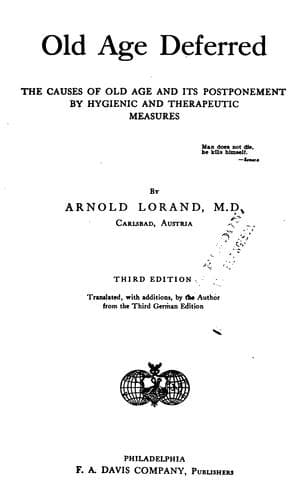
Old Age Deferred: The causes of old age and its postponement by hygienic and therapeutic measuresLorand, Arnold
Science
Old Age Deferred: The causes of old age and its postponement by hygienic and therapeutic measures
Lorand, Arnold
Hygiene; Longevity; Old age
------------------------------------------------------------------------
CHAPTER XIII.
THE DESTRUCTION OF TOXIC PRODUCTS BY THE LIVER AND THE IMPROVEMENT OF
ITS PROTECTIVE FUNCTIONS.
THE liver is one of the most important of our organs. As Professor
Hemmeter, of Baltimore, says, “The liver is an organ secondary in
importance only to the heart. Living things can exist without stomachs.
They can live for forty days without eating, but mammalia can only live
a few days, sometimes not twenty-four hours, without a liver.” The
importance of the functions of the liver is illustrated in this
picturesque remark of Dr. Rovighi[172]: “Like unto Minos in Dante, the
liver tests the conscience of those that want to enter, and knows their
sins.”
Footnote 172:
Quoted after Professor Hemmeter. Address to Sixty-first Annual Meeting
of the Ohio State Medical Association, May 9-11, Canton, Ohio.
We introduce into our stomach and intestines a number of poisonous
substances which, if injected into our blood, would kill us, or at
least, cause grave intoxication. Yet because they are taken by the mouth
they are harmless, and the reason for this strange phenomenon is that
they must pass through the liver, being brought to this organ from the
intestines through the portal vein, and are there destroyed. This is
illustrated in the case of the Indian snake charmers, who acquire
immunity against snake-bites after having first sucked the poisonous
fang of the snakes and absorbed the toxin via the intestine. They
thereby gradually accustom their body to this terrible poison, which,
taken in this manner, is far less harmful, since it passes through the
liver. That the liver destroys various poisons was first shown by our
esteemed friend, Prof. Paul Heger,[173] of Brussels University, who
demonstrated by experiments that nicotin added to blood soon disappeared
after it had been passed through the liver artificially. After this
remarkable discovery other authorities have found reason to state that
the liver also destroys other poisons, in particular alkaloids:
strychnine and atropine (Professor Roger[174]), hyoscyamine (Heger and
Buys[175]), quinine, morphia, curare (Lussana). According to Schiff, and
Lautenbach, alkaloids undergo a chemical change under the influence of
the liver. As Slowzoff[176] found, the liver also protects us against
poisons such as arsenic; therefore we can understand why persons
suffering from hepatic disease cannot tolerate arsenic. This should be
taken into consideration when we are treating patients with cacodylates,
or with atoxyl.
Footnote 173:
Thèse de Bruxelles, 1873; Journal méd. de Bruxelles, 1877; C. R. de
l’Académie des Sciences, May, 1880.
Footnote 174:
Thèse de Paris, 1887.
Footnote 175:
Quoted from Hanot, Archives Gén. de Médecine, II, 895.
Footnote 176:
Slowzoff: Beitr. zur chem. Physiologie u. Path., p. 281, 1901.
Public-domain text, read in full here on John Shaqi.
Reviews
Reviews
No reviews yet
Be the first to share your thoughts on this work.
Elsewhere in the archive
Join the Discussion
Join the discussion
Sign in to leave a comment or review.
Sign InorCreate an account