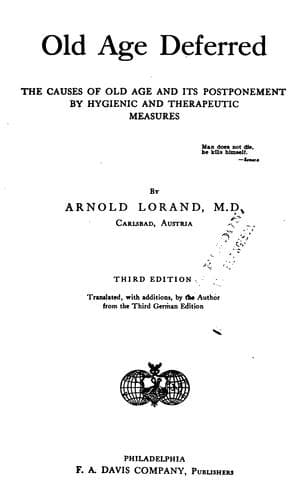
Old Age Deferred: The causes of old age and its postponement by hygienic and therapeutic measuresLorand, Arnold
Science
Old Age Deferred: The causes of old age and its postponement by hygienic and therapeutic measures
Lorand, Arnold
Hygiene; Longevity; Old age
It has, however, been maintained by Zagari that this antitoxic action of
the liver fails in the case of bacteria and, according to Professor
Roger, especially with bacterial toxins in old cultures.
Yet other authors have shown that the liver probably has an antitoxic
action against bacteria and their toxins. Thus, Professor Adami, of
Montreal,[177] by experiments with a minute diplococcus similar to that
which is found in Pictou’s cattle disease, and Sir Lauder Brunton, and
Dr. Bokenham,[178] have shown that the lethal action of diphtheria toxin
is greatly diminished during the circulation of this toxin through the
liver, and also that the juice from such a liver has a slight antitoxic
power. These authors have also shown that the bile from such a liver has
a slight antitoxic action. They consider that the antitoxic power of the
liver does not depend upon the blood present in the organ, but on the
liver-tissue itself.
Footnote 177:
Adami: Montreal Med. Journal, p. 485, July.
Footnote 178:
Sir Lauder Brunton and Bokenham: The Journal of Pathology and
Bacteriology, p. 50, Nov., 1907.
It has been shown that the liver excretes into the bile poisons which it
arrests during their circulation through the portal system. This has
been shown by Lussana in the case of curare. That poisonous substances
are excreted into the bile is shown also by the immunizing experiments
of Professor Koch against bovine plague. He employs the bile of animals
which died of plague. This contains attenuated plague bacilli, of which
Professor Koch makes use in his experiments.[179]
Footnote 179:
Quoted after Metschnikoff.
Dr. Fraser[180] has shown that when increasing doses of snake-venom are
injected into an animal a condition of immunity is brought about, so
that finally fifty times the dose which would have proved fatal at
first, becomes innocuous. As Fraser found, the bile of such animals
contains an antivenine, and he made use of this bile as an antidote
against the original venom.
Footnote 180:
Fraser: British Med. Journal, vol. ii, p. 595, 1897.
Public-domain text, read in full here on John Shaqi.
Reviews
Reviews
No reviews yet
Be the first to share your thoughts on this work.
Elsewhere in the archive
Join the Discussion
Join the discussion
Sign in to leave a comment or review.
Sign InorCreate an account