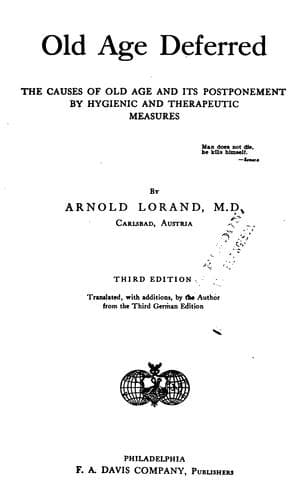
Old Age Deferred: The causes of old age and its postponement by hygienic and therapeutic measuresLorand, Arnold
Science
Old Age Deferred: The causes of old age and its postponement by hygienic and therapeutic measures
Lorand, Arnold
Hygiene; Longevity; Old age
Still the fact remains that the urine of many cases of liver disease has
been found to be more toxic than the urine of other persons.
When the liver is damaged it cannot destroy poisons in the normal
manner, as was shown by experiments. Thus, the liver cells have been
experimentally injured when it was found that such a liver was not able
to destroy strychnine as well as a normal liver. Very important findings
have been made by Roger and Gamier.[185] They have ascertained that
privation, bad nutrition, etc., can also lower the vitality of the liver
and diminish its antitoxic properties.
Footnote 185:
Roger et Garnier: C. R. Soc. de biol., p. 209, 1899.
------------------------------------------------------------------------
CHAPTER XIV.
THE HYGIENE OF THE LIVER.
WE have often observed that people suffering from diseases of the liver
feel and look much better after abstaining from meat and living on milk
and a vegetarian diet. If such a diet be beneficial in cases where the
tissues of the liver are degenerated, it appears reasonable to assume
that it will be equally efficacious when the liver has not yet been
altered by disease. We must realize that the various unwholesome matters
we eat or drink are carried to the liver to be dealt with, and that the
end-products of the decomposition of the meat, and other elements
contained in preserved meat which may not be perfectly sound, may injure
the liver-tissue, or, at any rate, throw more work on this organ than
food in the nature of vegetables or milk.
A milk diet has the further great advantages that it assists in
destroying toxic products in the intestine, and also that it can hinder
the development of gall-stone disease (see Chapter XXXIX).
Not only meat used in abundance, but also various kinds of spices,
condiments and stimulants may be very injurious, especially alcohol, if
taken in large quantity. Gin and brandy are the most deleterious in
their action. Wines containing little alcohol are less harmful, but acid
or strong white wines may injure the liver-tissue.
The well-being of this organ is essentially dependent on the good
condition of various other organs with which it stands in very close
relation, in particular the intestines, for instance. It is from here
that most of the toxic products enter the liver, either by the portal
vein or through the choledochus. The intestine always contains myriads
of microbes, which may enter the liver either by the blood or the bile,
and thus provoke very important changes in the liver-tissue. Professor
Adami,[186] of Montreal, found colon bacilli in a cirrhotic liver.
Footnote 186:
Quoted from Quincke: “Diseases of the Liver” in Nothnagel’s
“Practice.”
Public-domain text, read in full here on John Shaqi.
Reviews
Reviews
No reviews yet
Be the first to share your thoughts on this work.
Elsewhere in the archive
Join the Discussion
Join the discussion
Sign in to leave a comment or review.
Sign InorCreate an account