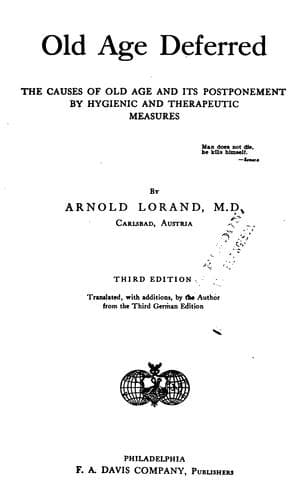
Old Age Deferred: The causes of old age and its postponement by hygienic and therapeutic measuresLorand, Arnold
Science
Old Age Deferred: The causes of old age and its postponement by hygienic and therapeutic measures
Lorand, Arnold
Hygiene; Longevity; Old age
As we have seen above, the liver receives an enormous amount of toxic
products from the stomach and intestine, which it transforms or
destroys. Like any other organ which is overworked, the liver may
undergo certain changes when continually subjected to a strain, and
great quantities of these toxins might be able, after a long-continued
action, to alter the liver tissue. Such a condition we may note in
gastric and intestinal diseases, especially in those cases where large
amounts of fatty acids are formed.
Bouchard found an enlargement of the liver in 23 per cent. of all his
cases of dilatation of the stomach.
We can understand that when fatty acids, as a result of
gastro-intestinal disease, pass for a long time through the liver, they
may destroy the delicate epithelium of this organ. Boix demonstrated
this by experiments. By feeding animals with lactic, butyric, and acetic
acids, he produced hepatic cirrhosis.
So long as the liver is healthy it is able to withstand the constant
inflow of toxins and will transform them into less harmful compounds.
But when the liver is altered, as in cirrhosis, things are different. We
then find a diminution of urea, and an increase of ammonia. Happily such
a condition arises only when there are considerable anatomical and
histological changes in the liver.
Salaskin and Zaleski have shown in animals that when there are serious
anatomical changes in the liver, the ammonia is increased, and the urea
is diminished. We may suppose that in old age, when the connective
tissue is more or less increased and important liver elements destroyed,
a similar decrease in the urea formation may take place just as in
chronic cirrhosis.
That in diseases of the liver toxic products are formed and eliminated
by the urine in increased amounts, has been shown by Professors
Bouchard[181] and Roger. They found that the urine of patients suffering
from diseases of the liver is more toxic than that of normal persons.
Footnote 181:
Leçons sur les auto-intoxications dans les maladies.
That the normal urine is toxic has been proved by Séglas and
Vauquelin,[182] and also by Bocci.[183] Bouchard has designated as the
urotoxic unit the quantity of urine necessary to kill an animal weighing
1 kilogramme, and as the urotoxic co-efficient the relation of the
urotoxin eliminated in twenty-four hours to the body weight of the
animal. This latter, then, indicates the quantity of urotoxins a man
eliminates in twenty-four hours.
Footnote 182:
Journal de Magendie, vol. ii, p. 357, 1822.
Footnote 183:
Centralbl. für med. Wiss. 51, 1882.
All these calculations of Bouchard have had no great success, however,
for many authorities, as Gumprecht,[184] Heymans v. d. Bergh, etc., have
shown that the toxic effects of the injected urine may be explained in
part by the difference in osmotic pressure between the injected urine
and the blood.
Footnote 184:
Centralbl. für Inner. Med., 24, 1897.
Public-domain text, read in full here on John Shaqi.
Reviews
Reviews
No reviews yet
Be the first to share your thoughts on this work.
Elsewhere in the archive
Join the Discussion
Join the discussion
Sign in to leave a comment or review.
Sign InorCreate an account