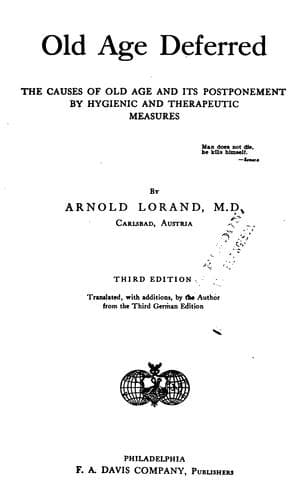
Old Age Deferred: The causes of old age and its postponement by hygienic and therapeutic measuresLorand, Arnold
Science
Old Age Deferred: The causes of old age and its postponement by hygienic and therapeutic measures
Lorand, Arnold
Hygiene; Longevity; Old age
These experimental facts, together with observations by Dr. Sajous,
prove that the atheromatous condition brought about after using certain
drugs, such as alcohol and tobacco, can be ascribed to the adrenals.
Josué, in 1893,[199] showed that by injecting adrenal extracts (solution
1:1000) into the veins of a rabbit, atheromatous patches of the aorta
will appear after five or six weeks. The changes described by Adler and
Hensel from the effects of nicotine confirm the probability that tobacco
acts on the adrenals first, then, by their medium, on the blood-vessels
(see, also, Chapter XLIII).
Footnote 199:
C. R. Soc. biologie, Nov. 14, 1893.
The above observations show that the same is also probable in the case
of alcohol, to which we may add a case of Widal and Boivin, who found in
a young woman dipsomaniac a hyperplasia of the adrenals and atheroma of
the aorta; and to complete the value of these observations we subjoin
those of a series of cases of atheroma by Joshua, in three of which a
hyperplastic condition of the adrenals was found.
It follows logically from the foregoing effects of alcohol and tobacco,
that we must avoid large quantities of these substances if we desire to
keep in a normal condition the heart and blood-vessels, upon the perfect
state of which depends, in a great degree, our chances of a long life
and extended youthfulness.
We will deal further with the latter points in the following chapter.
------------------------------------------------------------------------
CHAPTER XVI.
HYGIENE OF THE ADRENALS AND OF THE CIRCULATORY SYSTEM—A FEW REMARKS ON
THE CAUSE, PREVENTION, AND TREATMENT OF ARTERIOSCLEROSIS.
IN order to obtain the best hygienic condition of the circulatory
system, it is indispensable to avoid all that are harmful to the
adrenals. There can no longer be any doubt that these glands exercise a
controlling influence on the heart and the whole circulatory system.
They are in intimate relation with the principal nerves that regulate
the heart: the sympathetic and the vagus. Thus, for instance, emotions
that act on these nerves excite through them a hypersecretion of the
adrenals and a contraction of the small blood-vessels, with a rise in
the blood-pressure. By the hyperactivity of these glands their
secretion, in larger quantity than usual, is thrown out into the system,
producing toxic effects which result in an atheromatous condition of the
arteries. According to our present knowledge, we imagine this
atheromatosis to be due to the toxic effect of the adrenals quite
independently of the increase in the blood-pressure, for it has been
distinctly shown that even substances which diminish blood-pressure,
such as amyl nitrite, for example, are also capable of producing
atheroma. The toxic effects of adrenalin are proved by the experiments
of Amberg[200] in the laboratories of the Johns Hopkins University.
Footnote 200:
Public-domain text, read in full here on John Shaqi.
Reviews
Reviews
No reviews yet
Be the first to share your thoughts on this work.
Elsewhere in the archive
Join the Discussion
Join the discussion
Sign in to leave a comment or review.
Sign InorCreate an account