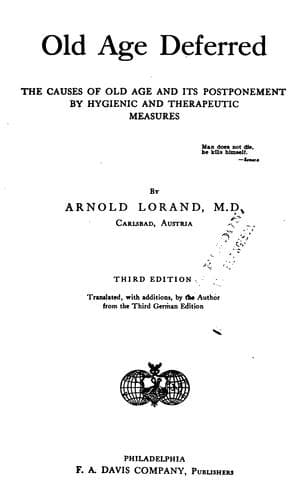
Old Age Deferred: The causes of old age and its postponement by hygienic and therapeutic measuresLorand, Arnold
Science
Old Age Deferred: The causes of old age and its postponement by hygienic and therapeutic measures
Lorand, Arnold
Hygiene; Longevity; Old age
There are many members of the profession who attach no importance to the
occasional appearance of a hyaline cast. But, considering the finding of
Professor Senator[225] that such casts are formed by degeneration of the
tubular epithelium, we cannot take such a lenient view; for even if we
find only one cast in two or three microscopic specimens, we must
realize how many thousands of these there may be in a liter of urine.
Thus every day thousands of these casts, and in a year enormous
quantities, may be lost. But as each cast means the loss of important
secreting elements, there can be no doubt that, after a certain time, we
shall have lost an important part of these most important organs, whose
place is taken by connective tissue. Thus the development of
interstitial nephritis can be hastened by faults in our alimentary
régime. In cases where meat is taken abundantly it is most probable that
the continual excretion from the blood of nitrogenous end-products of
metabolism means a serious overwork for the kidneys and grave damage to
their epithelium. And still more so if, owing to a diminished activity
of the liver due to senile degeneration, toxic products of a higher
toxicity than urea, and even uric acid, are passed.
Footnote 225:
Senator: Loc. cit.
We have observed the great frequency of albuminuria and casts in the
urine of persons who were addicted for many years to a plentiful meat
diet. According to Dr. James Tyson,[226] who has been for many years
making accurate observations on diseases of the kidneys, and who has
published a standard work on them, interstitial nephritis can be
produced after the prolonged ingestion of much meat. If we wish to keep
our kidneys in the best condition, a lacto-vegetarian diet with only
little meat, once a day, is the most suitable. Still more than meat,
bouillon and meat gravies should be avoided, since they contain
irritating meat extracts.
Footnote 226:
Tyson: A treatise on “Bright’s Disease and Diabetes,” second edition,
London, 1904.
Milk diet in abundance is not only indicated in liver disease, but also
in chronic kidney troubles. But when there are coexisting changes in the
circulatory system, milk should not be given in large quantities, but in
smaller amounts. Milk has also the great advantage of being a strongly
diuretic substance, especially in its acidulated forms (yogurth or
kefyr, or simple sour milk); and at the same time it irritates the
kidneys very little, since it contains only a minute amount of common
salt.
Public-domain text, read in full here on John Shaqi.
Reviews
Reviews
No reviews yet
Be the first to share your thoughts on this work.
Elsewhere in the archive
Join the Discussion
Join the discussion
Sign in to leave a comment or review.
Sign InorCreate an account