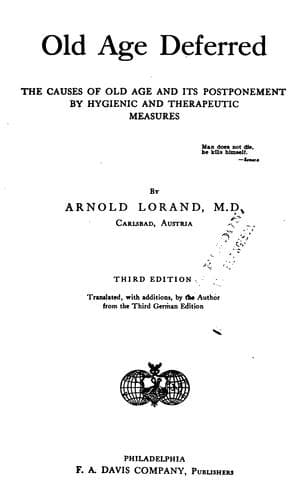
Old Age Deferred: The causes of old age and its postponement by hygienic and therapeutic measuresLorand, Arnold
Science
Old Age Deferred: The causes of old age and its postponement by hygienic and therapeutic measures
Lorand, Arnold
Hygiene; Longevity; Old age
According to Bunge, we take decidedly too much salt every day, and in
this way we injure our kidneys considerably. Achard,[227] Strauss,[228]
Vidal and Javal,[229] and simultaneously H. Strauss, have found that
diseased kidneys (especially in acute or chronic parenchymatous
inflammations) are unable to eliminate sodium chloride properly, and its
retention leads to œdema. According to these authorities, œdema is
caused by a retention of water and sodium chloride, the retention of the
latter playing the primary rôle, whereas according to Alexander Koranyi,
Richter, Kovesi, and Roth-Schulz, the retention of the water is the
primary factor.
Footnote 227:
Achard: Presse méd., 1901.
Footnote 228:
Strauss: “Die chronischen nierenentzundungen,” Berlin, 1902.
Footnote 229:
Vidal et Javal: Soc. Méd. des Hôpitaux, Juil. 31, 1903.
For these reasons salt should only be taken in very small quantities.
Alcohol should also be avoided, except in small quantities, as being
very injurious to the kidneys; and considering that chronic nephritis
may be caused by the immoderate use of alcohol, Bunge thinks that the
chronic nephritis following large quantities of alcohol may be
attributed to the fact that, according to the researches of Keller,[230]
made in Bunge’s laboratory, the alcohol habit leads to an immoderate use
of salt with its deleterious effects upon the kidneys.
Footnote 230:
Keller: Zeitschrift für Physiol. Chemie, vol. xiii, p. 130 and 134,
1889.
According to Bunge, rice gives very little work to the kidneys, as in
twenty-four hours only 2 grammes of alkaline salts are eliminated. On
the other hand, potatoes cause a very great elimination of salt by the
kidneys. Bunge thinks that rice would be a good food for patients with
renal disease.
Not only alcohol, but other stimulants, like tea, can be of harm to the
kidneys if taken in large quantities, as we have mentioned in the
preceding chapter when speaking of black tea.
We do not think, however, that the daily use of black tea, in moderate
quantities, would have unfavorable effects on the kidneys. Its relation
to the production of uric acid should, however, be remembered (see
chapter on other stimulants: coffee, tea, tobacco, etc.).
For reasons already mentioned, irritating spices and adulterated sauces
should be very carefully avoided; also all kinds of food which contain
pungent ingredients. We have no doubt that by their use life is often
shortened. The passage of such poisonous substances for years through
our kidneys must injure their delicate structure and hasten the
development of the senile kidneys, with interstitial nephritis.
Public-domain text, read in full here on John Shaqi.
Reviews
Reviews
No reviews yet
Be the first to share your thoughts on this work.
Elsewhere in the archive
Join the Discussion
Join the discussion
Sign in to leave a comment or review.
Sign InorCreate an account