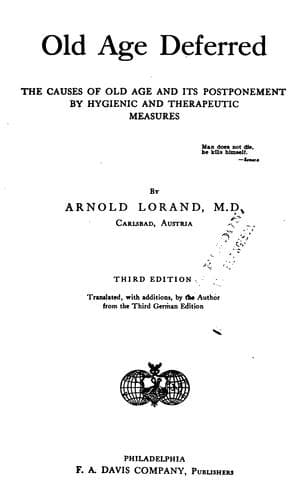
Old Age Deferred: The causes of old age and its postponement by hygienic and therapeutic measuresLorand, Arnold
Science
Old Age Deferred: The causes of old age and its postponement by hygienic and therapeutic measures
Lorand, Arnold
Hygiene; Longevity; Old age
The danger of the close room should be brought home to all, even
children, through instruction in hygiene in the public schools; and even
from their very youngest days this should be instilled into the minds of
youth, together with the contra-advantages of fresh air. By these means
they will be accustomed to the fresh air and its beneficial effects, as
much as they will learn to detest the horrors of the air exhaled by
other people, which is the source of so many infections. Every one who
wishes to enjoy life during youth, and live to a good old age, should
abominate a close room and never, if he can possibly help it, pass an
hour in such an atmosphere.
------------------------------------------------------------------------
CHAPTER XXXIII.
HYGIENE OF ARTIFICIAL HEATING—THE DANGERS OF HEAT BY STEAM AND A FEW
HINTS ABOUT THEIR PREVENTION.
OLD people are particularly sensitive to cold, and they therefore need a
warm room when the temperature falls in the autumn. In old age,
especially in its advanced stage, the processes of oxidation are
diminished, and thus less natural warmth is produced; but, as we give
off more heat in cold weather, it is only natural that they will feel
the cold then much more than younger individuals.
The rooms, therefore, in which old people live must be kept very warm,
in the same manner as we do with infants, especially for those who come
of parents with degenerated thyroids. Thus we see again how old age and
infancy present many parallel features.
But, if a very warm room be compulsory for aged folks, no such necessity
exists in the case of the young or middle aged, and it is abusing their
health if they remain long in rooms heated above 75° to 85°, or
sometimes 90°, where, at the same time, every window is sedulously
closed on all sides, so that no fresh air can find entrance. Such
overheated rooms we usually find in northern climates, and the air in
such cases is frequently hotter in the house in winter than we find it
in the open on a comfortably warm summer day, when, being in the open,
the heat can certainly be better borne than in a close room.
In America many things are better than in Europe; but this certainly
does not apply to the method of heating used in the majority of the
houses, hotels, and office buildings, all of which are mostly
overheated, and that by steam heat, and very frequently with defective
ventilation, if there be any at all. The worst part of it is that a
uniform heat is maintained, whether it be a warm or a cold day; thus,
the air temperature was 55° F. on October 15, 1906, when I was in New
York, and in one of the most fashionable hotels the temperature was 75°
F. In Houston, Texas, there was a heat wave in February, 1907, with
disagreeable hot weather, yet 70° F. of steam-generated heat was
maintained in the hotels, which made life unbearable for those who, like
the author of this book, are so fond of fresh air.
Public-domain text, read in full here on John Shaqi.
Reviews
Reviews
No reviews yet
Be the first to share your thoughts on this work.
Elsewhere in the archive
Join the Discussion
Join the discussion
Sign in to leave a comment or review.
Sign InorCreate an account