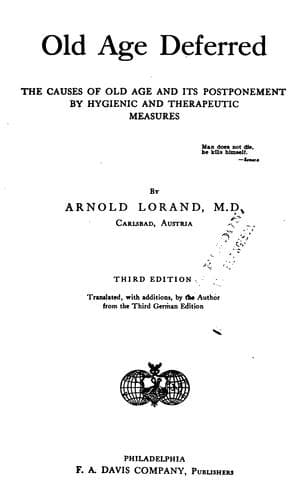
Old Age Deferred: The causes of old age and its postponement by hygienic and therapeutic measuresLorand, Arnold
Science
Old Age Deferred: The causes of old age and its postponement by hygienic and therapeutic measures
Lorand, Arnold
Hygiene; Longevity; Old age
As we are endeavoring in this work to give hints how to reach a ripe old
age and prevent diseases which may dissipate our hopes in that
direction, it is our duty to protest and to point out the dangers of
such irrational heating.
It seems to me, however, that in some northern countries in Europe
things are not much better, especially since steam heat is becoming more
and more used, as in Norway, even in the private houses. In some of
these countries—Russia, for instance—cotton is put around the window
panes to exclude the air, and also to absorb the moisture condensed on
the inside of the double windows.
In many European countries, however, fireplaces and stoves are common.
The most rational method of heating, though not the most economical, is
the open fireplace in England, whence the most ventilation is obtained;
for the essence of the problem is to obtain warmth and fresh air at the
same time. English, Scotch, and Irish are most sensitive to an
overheated room, and they are probably the most healthy inhabitants of
Europe, too. While a guest, some years ago, of friends in Derbyshire, I
well remember that, directly the temperature rose above 65, the windows
were thrown open.
Americans in Europe often complain that they are not warmed at the
fireplace, which only keeps the face and not the body warm. This,
however, will only apply to those who only feel comfortable at a
temperature of 75° F., which is distinctly unhealthy; for the open
English grate can very easily produce the standard temperature of 15° R.
(about 18° C.), which should not be exceeded if we want to have a
healthy warmed atmosphere in our rooms. Of course such fireplaces can
produce a much higher temperature, but even then the air is never so
offensive as that of rooms heated by steam.
It would seem, at first thought, that women can withstand cold much
better than men, considering how much lighter is their dress and how
much more it exposes them to cold air. We sometimes see young girls of
the poorer class in such light clothing in mid-winter, standing in the
streets and talking with their friends, that we men shiver at the mere
idea of such clothing. Yet it is women who most need a warm room,
probably because their dress is much the same indoors in mid-winter as
in mid-summer. They, however, when out-of-doors wear heavy furs which
entirely check the respiration of their skin; and their light clothes,
when indoors, do not afford much opportunity for their skin respiration,
for then there is usually no fresh air in the house, but an oppressive
heat, all air ventilators being sedulously closed. It is strange how
people try, by every means, to destroy their health!
In warm weather we give off less warmth and do not require so much food
in order to produce warmth, as the natural temperature also requires
less of us; in summer, therefore, we need less nourishment.
Public-domain text, read in full here on John Shaqi.
Reviews
Reviews
No reviews yet
Be the first to share your thoughts on this work.
Elsewhere in the archive
Join the Discussion
Join the discussion
Sign in to leave a comment or review.
Sign InorCreate an account