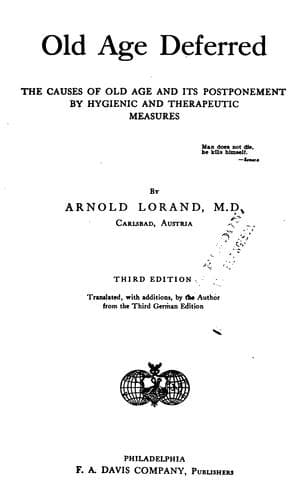
Old Age Deferred: The causes of old age and its postponement by hygienic and therapeutic measuresLorand, Arnold
Science
Old Age Deferred: The causes of old age and its postponement by hygienic and therapeutic measures
Lorand, Arnold
Hygiene; Longevity; Old age
In addition to the above nutritive elements there are also a series of
extractive substances to which is due the pleasant taste of the meat.
When such food is boiled these substances and salts pass into the water,
and such meat loses in flavor, though not in its nutritive qualities,
for the water i.e., the soup is not nutrimental at all. Meat, if
prepared for the table directly after the animal is killed, would not be
palatable; and it is, therefore, necessary for it be kept for a given
time before it is eaten. Dr. Wiley, of Washington, considers that meat
improves if kept not exceeding fourteen days in cold storage, after
which time it begins to lose its best qualities.
When meat is chilled it does not lose its pleasant taste; but when it is
frozen the case is very different, for then it loses its beneficial
juices, which escape into the surrounding ice. In such meats, therefore,
the extractives which give the pleasant flavor are wanting. Refrigerated
meat generally arrives in Europe in excellent condition from America.
Before animals are slaughtered to be used for food a rigorous
examination by veterinarians must be made, in order to avoid poisoning
from meat in a condition of putrefaction, or from diseased animals. Some
animals, such as pigs, very often suffer from acute inflammatory
diseases caused by catching cold while on long journeys prior to being
slaughtered. Fortunately, in the early stages of such illness there is
little danger, for it can be avoided by thorough bleeding. The Jewish
method of bleeding an animal is thus particularly to be recommended, for
by this means poisonous products can leave the animals’ bodies in large
quantities. Meat retaining all the natural blood decomposes very
rapidly, especially in hot climates, and we must not forget that such
poisonous substances, as ptomaines, in meat, are not destroyed by the
process of cooking.
The greatest danger from poisoning lies in oysters, which are otherwise
a most digestible food. This is owing to the frequent presence of sewage
contamination in the waters where they are bred, thereby causing
veritable epidemics of typhoid fever. Just as in fish foods, oysters and
mussels, sausages in the meat foods are the most frequent cause of
poisoning when they are not quite fresh and thoroughly sound, and from
such a cause epidemics from poisoning are frequent in Germany. Sausages
are a very nutritious food, as they contain a large amount of fat; their
greater value when made from the blood of pigs, on account of its
richness in iron, will be specially dealt with in another chapter.
Fish contain somewhat less albumin and much more water than meat, but
some of them are rich in fat, such as the eel. We show in the following
table the nutritive values in each 100 parts of some of the most
frequently eaten fish:—
Public-domain text, read in full here on John Shaqi.
Reviews
Reviews
No reviews yet
Be the first to share your thoughts on this work.
Elsewhere in the archive
Join the Discussion
Join the discussion
Sign in to leave a comment or review.
Sign InorCreate an account