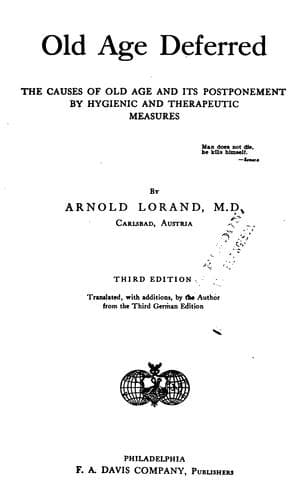
Old Age Deferred: The causes of old age and its postponement by hygienic and therapeutic measuresLorand, Arnold
Science
Old Age Deferred: The causes of old age and its postponement by hygienic and therapeutic measures
Lorand, Arnold
Hygiene; Longevity; Old age
────────────┬──────────┬──────┬──────────
│ Albumin. │ Fat. │Calories.
────────────┼──────────┼──────┼──────────
Herring │ 10.1 │ 7.1 │ 107
(Rubner) │ │ │
Haddock │ 17.1 │ 0.3 │ 73
(Rubner) │ │ │
Salmon │ 16.10 │ 5.50 │ 110
(Pavy) │ │ │
Eel (Rubner)│ 17.8 │ 28.4 │ 317
White fish │ 18.10 │ 2.90 │ 102
(Pavy) │ │ │
────────────┴──────────┴──────┴──────────
Fish contain as a rule very little extractive substances compared with
meat, and are therefore less tasteful; but still the fatter fish have an
agreeable flavor, and are pleasant to the taste. As a general rule, they
are more digestible than meat, and also have less of other disadvantages
than meat food, on which we will dwell more fully in another chapter.
On the other hand, it is more important than with meat that fish should
be absolutely fresh, which would be best attained by keeping them alive
in water until just before being required for the table. Boiled fish is
the most digestible, fried less so, and pickled or smoked the least.
The most perfect animal food is milk, as it contains all the three
principal elements of nourishment, and in normal digestive organs is
easily resorbed. As in the case of meat diet, we will deal more fully
with this most important and wholesome food in a special chapter. We
will content ourselves with mentioning here that milk not only contains
the three principal elements of food, but also most of the equally
important organic and inorganic minerals, without which life would be
impossible. It contains very important organic phosphorized combinations
in the shape of lecithin and nuclein; and of the inorganic salts, lime
exists in milk in a much greater degree than in any other food. Besides
the albumin, carbohydrates, and fat which it contains, milk comes under
the category of foods which are richest in mineral salts, especially
lime, of which cows’ milk contains 1510 milligrammes in every 100
grammes of desiccated substance, according to Bunge. In iron only is
cows’ milk very poor, and therefore when milk forms the main part of our
daily nourishment it will be necessary to partake of iron at the same
time, which we can best do by eating sausage and puddings made from
pigs’ blood (see Chapter XXXVIII).
According to Professor Rubner milk and the various products of milk
contain the three main elements of food, in each 100 parts, as follows:—
Public-domain text, read in full here on John Shaqi.
Reviews
Reviews
No reviews yet
Be the first to share your thoughts on this work.
Elsewhere in the archive
Join the Discussion
Join the discussion
Sign in to leave a comment or review.
Sign InorCreate an account