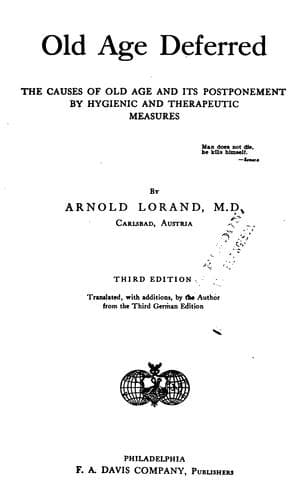
Old Age Deferred: The causes of old age and its postponement by hygienic and therapeutic measuresLorand, Arnold
Science
Old Age Deferred: The causes of old age and its postponement by hygienic and therapeutic measures
Lorand, Arnold
Hygiene; Longevity; Old age
From the above we see that peas, beans, and lentils have the most
nutritive properties, for they contain not only much albumin but also
much carbohydrates, and also more fat (except in the case of ground
Indian corn and rye), than the other above-mentioned vegetables.
Thus we shall not be surprised to learn that we can thrive very well for
a long time by using such exclusively for food, as has been proved by
the experiments of Rubner and Woroschiloff. The drawback to this kind of
food is that it requires the stomach and intestinal juices to perform
much more work, for reasons already mentioned; and, in consequence, less
of it is utilized; and, after a certain time, the development of stomach
and intestinal troubles is facilitated.
Another drawback attending vegetables is that they contain purin bodies
and form uric acid, indeed in considerable quantities, especially peas
and beans, as Walker Hall[266] discovered from experiments conducted in
the Caroline Institution at Stockholm. Of the various kinds of cereal
foods rice forms the least uric acid, and also, as already mentioned,
contains the least salt, for both of which reasons it is the best food
for the kidneys. It is, at the same time, a very valuable nutritive
food, as it contains a very large quantity of carbohydrates, viz.: 77.6
per cent., and almost the least cellulose of all foodstuffs, as shown in
the table above; but it is very poor in fat, and has also but a small
amount of albumin. As it contains so little proteid and fat its adoption
by people with vegetarian proclivities necessitates the simultaneous use
of leguminous vegetables and of fats. It has the advantage over
leguminous vegetables in that its starch components are extremely
digestible. Thus it is the most valuable vegetable food, in spite of its
being poor in mineral matters.
Footnote 266:
Walker Hall: Berliner klin. Wochenschrift, p. 868, 1903.
Granted the enormous value of rice as a foodstuff, we must express our
surprise that it enters in so small a degree into our daily diet. In
Europe, and in other parts of the world where persons of European
descent reside, as also in America, the potato takes the same place as
rice does in Asiatic countries, though the former is much less rich in
nutritive qualities, as we will show later on.
Rice must be a most excellent food, for the natives of Asiatic
countries, who live almost exclusively on this, offer us examples of
great tenacity, and of resistance against bodily fatigue. Take the
Japanese for example. Their coolies, as shown already, are able to do
enormous muscular work on rice and fish food, and in athletics, such as
jiujitsiu, they present a great example of muscular strength, though it
cannot be denied that it is more their dexterity and knack than their
superiority in mere strength that leads them to victory. That by means
of rice diet, as by carbohydrates, great muscular energy can be
obtained, is a well-known physiological fact.
Public-domain text, read in full here on John Shaqi.
Reviews
Reviews
No reviews yet
Be the first to share your thoughts on this work.
Elsewhere in the archive
Join the Discussion
Join the discussion
Sign in to leave a comment or review.
Sign InorCreate an account