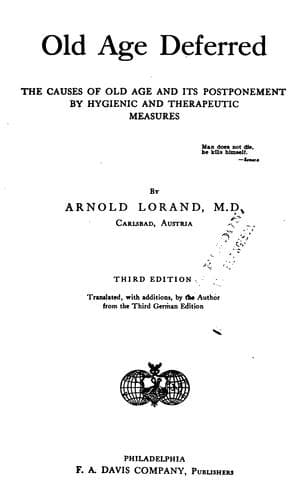
Old Age Deferred: The causes of old age and its postponement by hygienic and therapeutic measuresLorand, Arnold
Science
Old Age Deferred: The causes of old age and its postponement by hygienic and therapeutic measures
Lorand, Arnold
Hygiene; Longevity; Old age
The starchy portion is converted, through the digestive ferments in the
saliva, pancreatic, and intestinal juices, into dextrin and grape sugar;
absorbed through the intestines, it is deposited in the form of glycogen
in the liver, the muscles also absorbing a large part of this glycogen.
Through work this glycogen is exhausted. Thus work is performed mainly
at the expense of the carbohydrates, which are the prime generators of
muscular energy. We have also seen that the above-mentioned Japanese
coolies perform their incredible muscular efforts largely on such food
only. Still, a part of the muscular energy of the body can also be
provided by the proteids and fats.
Carbohydrate foods, and especially those that are poor in fatty
contents, such as rice, and especially potatoes, which are the most
deficient of all (having but 0.1 per cent. of fat), necessitate the
simultaneous use also of fat; for this kind of exclusively carbohydrate
diet would invariably lead to starvation unless there was a plentiful
supply of fat with it; and the best and most agreeable form to introduce
fat into the body is by means of butter.
Butter is very nutritious, as it contains, according to Rubner, 83.1 per
cent. of fat, 0.9 per cent. of albumin, and 0.5 per cent. of
carbohydrates. One hundred grammes of butter contain, according to
Rubner, 779 calories. In addition to the above, butter also contains
salts, and from 8 to 12 per cent. of water. A diet rich in carbohydrates
could not be well assimilated without butter; but, at the same time, the
abundant use of the latter also necessitates the use of carbohydrates,
which are the best vehicle for butter; therefore, when in diabetes we
prescribe much butter or other fats, we make it a rule, also, to give
some kind of food that contains some amount of carbohydrates, such as
brown bread or green vegetables, or sometimes, in mild cases, also
boiled potatoes.
Potatoes, when new and watery, contain 16 per cent. of carbohydrates;
when they are old, 22 per cent. In many European countries they form a
most important article of diet. Though, as shown in the foregoing table,
they contain only 2 per cent. of proteids, they contain also important
salts, such as a certain amount of citric acid and citrates of
potassium, sodium, and lime. Thus potatoes, by means of these salts, are
also an alkaline food, and if consumed in very large quantities, the
acidity of the urine can become much diminished. These salts are burned
in the body, and the potassium is then transformed into a carbonate
salt. Mossé recommends potatoes in large quantities as a preventive of
diabetes.
Public-domain text, read in full here on John Shaqi.
Reviews
Reviews
No reviews yet
Be the first to share your thoughts on this work.
Elsewhere in the archive
Join the Discussion
Join the discussion
Sign in to leave a comment or review.
Sign InorCreate an account