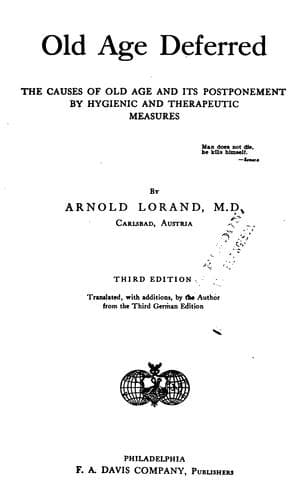
Old Age Deferred: The causes of old age and its postponement by hygienic and therapeutic measuresLorand, Arnold
Science
Old Age Deferred: The causes of old age and its postponement by hygienic and therapeutic measures
Lorand, Arnold
Hygiene; Longevity; Old age
Probably no cell growth can take place without lime, and even if grown
animals are fed on a diet containing no lime they soon become weak and
will certainly die at some time from it; therefore not only children,
but adults also, must obtain a sufficient quantity of this, and milk or
water that contains lime is certainly the best means by which to get it.
Very interesting are the observations of Roese,[269] showing that in
parts of Germany where water poor in lime is drunk less people are fit
for military service and the teeth of the population generally are in
bad condition. Lime is indispensable for our body, for it has a
favorable influence upon the work of the heart, the secretion of stomach
juice, and the movements of the intestines; it increases the quantity of
the urine; and, as Lehmann, Posner, and v. Noorden have shown, the
carbonate of lime dissolves uric acid.
Footnote 269:
Roese, “Erdsalzarmuth und Entartung,” Berlin, 1908.
Another most important mineral salt is iron, this being an essential
element of the hæmoglobin of the blood. This latter is the red coloring
matter of the blood, and consists of the combination of an albuminous
body-globulin with a ferruginous body, the hæmatin. According to
Bunge,[270] a man weighing 70 kilos has in his blood 3.2 grains of iron,
and according to Schmidt from 2.4 to 2.7 grains.
Footnote 270:
Bunge: Loc. cit.
Bunge maintains that organic iron is more readily absorbed than
inorganic iron, and that the best way to obtain sufficient iron in the
body will be to choose a food that is rich in iron
We present below a table by Bunge, showing the various articles of food
that contain the greatest percentage of iron; 100 grammes dried
substance contain milligrammes of iron:—
Pig’s blood 226
Spinach 33 to 39
Asparagus 20
Yolk of eggs 10 to 24
Beef 17
Cabbage, green 17
leaves
Apples 13
Red cherries 10
Almonds 9.5
Lentils 9.5
Strawberries 8.6 to
9.3
Carrots 8.6
White beans 6.2 to
6.6
Black cherries 7.2
Peas 6.2 to
6.6
Potatoes 6.4
Huckleberries 5.7
Grapes 5.6
Wheat 5.5
Rye 4.9
Public-domain text, read in full here on John Shaqi.
Reviews
Reviews
No reviews yet
Be the first to share your thoughts on this work.
Elsewhere in the archive
Join the Discussion
Join the discussion
Sign in to leave a comment or review.
Sign InorCreate an account