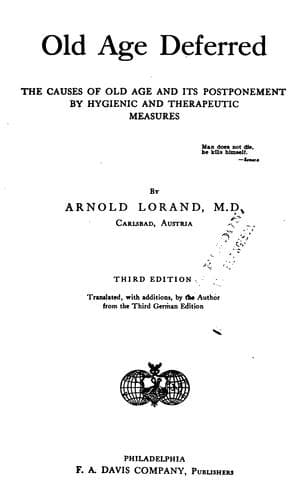
Old Age Deferred: The causes of old age and its postponement by hygienic and therapeutic measuresLorand, Arnold
Science
Old Age Deferred: The causes of old age and its postponement by hygienic and therapeutic measures
Lorand, Arnold
Hygiene; Longevity; Old age
Since milk food contains scarcely any products harmful to the liver,
even when taken in large quantities, and considering at the same time,
the antiseptic action of milk food upon the bacilli in the intestines,
it is easy to understand that with such a diet little work is thrown
upon the liver, and its tissues are not damaged. We have been surprised
to see how well patients with liver or gall-stone trouble looked after a
diet of milk and vegetables for several weeks. The importance of such a
diet upon the condition of the bile passages is shown by the well-known
fact that inflammation of the bile-ducts and gall-bladder can be caused
by the immigration of bacilli from the intestine. It follows that with a
lessened amount of intestinal bacilli, the bile passages will not be so
liable to infection, and by a milk diet, especially one of sour milk,
kefir, koumiss, etc., we can limit, to a large extent, the number of
bacteria in our intestines. Therefore such a diet would be calculated to
prevent disorders of the gall-ducts and bladder and gall-stone disease,
which are so often found in elderly persons.
Milk is a food which contains scarcely any extractives. In consequence
it is an ideal food for the kidneys, through which it passes without
causing the least injury to these vital organs, which cannot be said of
meat with its numerous extractive substances. Milk contains very little
salt, which qualifies it as a most excellent food for the kidneys. Milk
diet has rightly been given since the early days of medicine in kidney
troubles. Since in old age there is an increase of connective tissue in
the kidneys, with impairment of their eliminative capacity, on this
account also milk diet is the most suitable for old persons.
In order to derive the greatest possible benefit from this most
excellent food, it would be necessary to take human milk, as thus we
introduce into our system the internal secretions of human ductless
glands and human ferments. Such good fortune can, however, only fall to
the lot of infants, and, we are sorry to say, not to all of them.
Therefore we are obliged to use the milk of those animals which is next
best to human milk—for example, asses’ milk. This, however, cannot be
obtained easily; two pints of it would cost, in some places, about a
dollar. The next best substitute is goats’ milk, which also contains ten
times as much iron as cows’ milk. It is a great puzzle to us why the
milk of this animal, which is richer in fat and albumin than cows’ milk,
is not more used. Perhaps the main objection is the occasionally
disagreeable smell, which, however, can be avoided by keeping the goat
very clean. The goat is rarely subject to tuberculosis, which also is a
strong argument for the use of its milk.
Public-domain text, read in full here on John Shaqi.
Reviews
Reviews
No reviews yet
Be the first to share your thoughts on this work.
Elsewhere in the archive
Join the Discussion
Join the discussion
Sign in to leave a comment or review.
Sign InorCreate an account