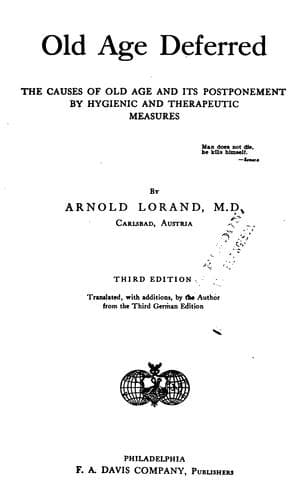
Old Age Deferred: The causes of old age and its postponement by hygienic and therapeutic measuresLorand, Arnold
Science
Old Age Deferred: The causes of old age and its postponement by hygienic and therapeutic measures
Lorand, Arnold
Hygiene; Longevity; Old age
There can be no doubt that, for those who can stand it in large
quantities, milk is an excellent aid in the fight against old age and in
its treatment. As most constituents of the blood enter the milk, perhaps
it is not too daring to say that drinking milk is, in a measure,
drinking blood. Evidently blood contains all the internal secretions of
the ductless glands as well as most valuable ferments; hence the
rational prevention and treatment of old age would consist in drinking
blood. There is, however, no general tendency to such bloodthirsty
methods at the present time, but, maybe, it will be used in the future.
But if we cannot drink blood let us drink milk, the most valuable food
there is.
------------------------------------------------------------------------
CHAPTER XL.
ON BLOOD AS AN ARTICLE OF FOOD CONTAINING IRON AND ANIMAL
EXTRACTS—SAUSAGES AND BLOOD PUDDINGS.
IRON is a most important element of our blood, the lack of which, as in
chlorosis and various anæmic conditions, may produce very serious
symptoms. To replace this deficiency iron is introduced into our system,
and this can be done in two ways: either by the natural way, i.e., by
food which contains iron, or artificially, by means of drugs which
contain iron. It is the opinion of Bunge that iron, given in drugs,
especially as inorganic iron, is not so readily absorbed and assimilated
as organic iron, i.e., iron as it occurs in various articles of food,
and especially in the blood.
Therefore an effort has been made with more or less success by
manufacturing chemists to make preparations of iron obtained from the
blood, and Professor Bunge[299] has experimented on animals by using
iron containing nuclein, separated from the yolk of eggs; and in
Professor Kossel’s laboratory such a preparation has been made from the
eggs of the carp. It was found that these preparations were perfectly
absorbed and assimilated.
Footnote 299:
Bunge: Lehrbuch der Physiologie, Berlin, 1907.
Professor Bunge, and also his pupils Abderhalden and Haüsermann, found
that all animals which received food containing but little iron, became
anæmic, e.g., young rabbits fed only on milk, which, as above mentioned,
is very poor in iron. Later food was given that contained iron (as green
vegetables, cabbage, herbs, etc.; or meat, yolks of eggs, and fruit),
and soon afterward the iron contents of their blood was found to be
increased. Even if we are not anæmic or chlorotic, it is necessary to
take a certain amount of iron, preferably organic iron, into our
systems.
Public-domain text, read in full here on John Shaqi.
Reviews
Reviews
No reviews yet
Be the first to share your thoughts on this work.
Elsewhere in the archive
Join the Discussion
Join the discussion
Sign in to leave a comment or review.
Sign InorCreate an account