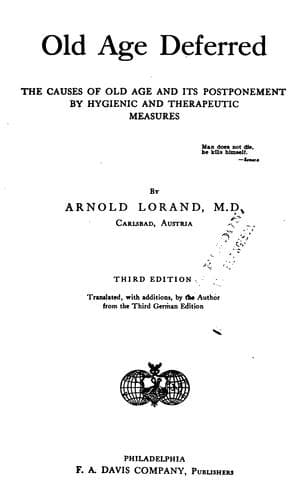
Old Age Deferred: The causes of old age and its postponement by hygienic and therapeutic measuresLorand, Arnold
Science
Old Age Deferred: The causes of old age and its postponement by hygienic and therapeutic measures
Lorand, Arnold
Hygiene; Longevity; Old age
Bunge mentions that the chlorotic girls of Basel (Bâle) come to the
slaughterhouses in order to drink the blood of animals that have just
been slaughtered. The question arises as to which animal’s blood is the
best. That of the pig is preferable for several reasons. Its blood
contains much iron (according to Bunge 226 milligrammes in every 100
grammes), its organs are anatomically and histologically very like our
own, and the pig is an omnivorous animal, as we are, being able to eat
even 14 to 20 pounds of meat a day. Several of the organo-therapeutic
preparations, like ovarian extracts, and testicular and kidney extracts,
are, if obtained from the pig, more active than those obtained from
other animals. And, finally, from pigs’ blood very savory sausages and
puddings can be prepared.
In Denmark and Norway a favorite pudding is prepared from pigs’ blood,
together with flour, sugar, barley, groats, and raisins, and we have
found it very palatable. In these countries many physicians prescribe
this pudding and blood sausages (in England called “black puddings”) to
chlorotic girls.
We consider pigs’ blood to be of very great value, not only on account
of its iron, but also because it contains, as does blood in general
(according to Claude Bernard), extracts of the ductless glands in their
most assimilable form, and by taking this blood we, at the same time,
introduce these organic extracts. To obtain the greatest possible
benefit from these properties the blood should be drunk fresh; but as
this is not very easy to do for obvious reasons, we can substitute blood
sausages and black puddings. Blood contains chemical substances of great
importance, as iron, manganese, phosphorus and small quantities of
iodine, besides also lecithin, glycogen, glucose, jecorin, etc. It also
contains important ferments, as diastase, and sugar- and fat-splitting
ferments. Likewise it contains important immunizing substances,
opsonins, alexins, etc.
The blood of pigs is very nourishing, for it is rich in albumin. Indeed,
considering that this blood is wasted in the slaughter houses, it is
necessarily the cheapest kind of food. And it is also an article of food
which is easily digested, absorbed, and assimilated. It is hard to
understand why this article of diet has not been made more use of long
ago. Professor Bunge, the well-known physiologist, likewise strongly
recommends the use of blood as an important article of diet. We show in
the following table, compiled from the researches of Abderhalden,[302]
the composition of pigs’ blood and of ox blood in respect to their
nourishing qualities and different mineral contents.
Footnote 302:
Abderhalden: Zeitschrift für Physiolog. Chemie, 1898, 25, 56 (for
pigs’ blood); and Hidem, 1897, 23, 521 (for ox blood).
Public-domain text, read in full here on John Shaqi.
Reviews
Reviews
No reviews yet
Be the first to share your thoughts on this work.
Elsewhere in the archive
Join the Discussion
Join the discussion
Sign in to leave a comment or review.
Sign InorCreate an account