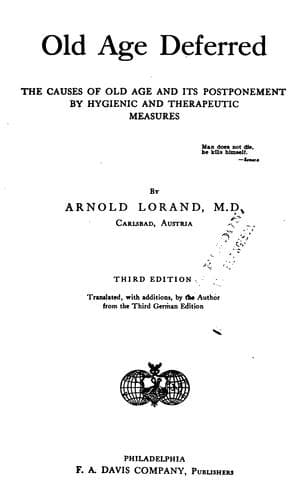
Old Age Deferred: The causes of old age and its postponement by hygienic and therapeutic measuresLorand, Arnold
Science
Old Age Deferred: The causes of old age and its postponement by hygienic and therapeutic measures
Lorand, Arnold
Hygiene; Longevity; Old age
Anæmia of slight degree is very frequent in women, especially after
degeneration of the ovaries, as after the menopause. As we have already
mentioned, the ovaries influence in a remarkable way the condition of
the blood. In the adult the bone marrow is the chief seat of formation
for the red blood corpuscles; but the bone marrow, and indeed the whole
skeleton, as we have shown in the second chapter of this book, is under
the control of the ovaries and of the thyroid. As these organs are, as a
rule, degenerated in old age, anæmia must result, and indeed Prof.
Naunyn[300] says: “Old people are anæmic.” Geist has already emphasized
the diminution in the quantity of the blood in old age. That blood
formation is deficient in old age is demonstrated by Besançon and Labbé,
who found the activity of the bone marrow diminished in old age, and by
Grawitz,[301] who found that bone marrow underwent important changes in
old age, being transformed into a jelly-like substance. According to
Grawitz, iron—and he always prefers to prescribe an organic rather than
an inorganic iron preparation—is less efficacious in old age. We
attribute this to the degeneration of the blood-forming organs, through
whose intermediary action iron produces its effect. If, however, these
organs are not entirely degenerated, but only partially so, as in the
first few years following the menopause—in women until the end of the
fifties—we can obtain better results; and indeed after giving such women
iron we may observe that they look better, and often fresher (see, also,
Chapter LIII). As organic iron is more easily assimilated, this form is
to be preferred, and the question arises: How should we take it? Of all
kinds of food used at present, spinach and the yolk of eggs contain the
most iron; so we could give these. Fortunately spinach is obtainable at
all seasons in the United States. For those who prefer eggs, yolks in
quantities large enough to satisfy our needs would not be easily
digested, and also as eggs would be difficult to procure fresh every
day, we must think of another expedient. We may take iron preparations
obtained from the blood of animals. But why not take the blood itself,
which contains iron in a form similar to that in our blood, and in
larger quantities than in any other food? This would certainly be more
efficacious, and also less expensive.
Footnote 300:
Naunyn: In Schwalbe’s Lehrbuch der greisenkrankheiten, Berlin, 1909.
Footnote 301:
Grawitz: Hidem and also in “Klinische Pathologie des Blutes,” third
edition, Leipzig, 1906.
Public-domain text, read in full here on John Shaqi.
Reviews
Reviews
No reviews yet
Be the first to share your thoughts on this work.
Elsewhere in the archive
Join the Discussion
Join the discussion
Sign in to leave a comment or review.
Sign InorCreate an account