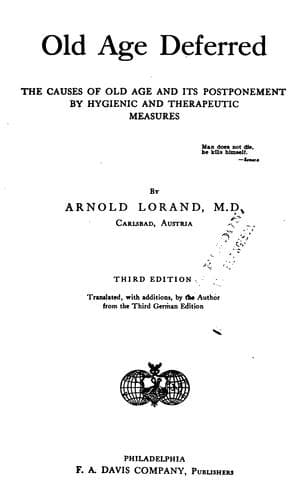
Old Age Deferred: The causes of old age and its postponement by hygienic and therapeutic measuresLorand, Arnold
Science
Old Age Deferred: The causes of old age and its postponement by hygienic and therapeutic measures
Lorand, Arnold
Hygiene; Longevity; Old age
IN everyday life we are exposed to worry and disappointment; and also,
as many of us easily tire after work, we frequently feel an inclination
to take something to cheer us up and to incite us to further exertions;
thus we take stimulants, such as alcohol, tea, coffee, tobacco, etc.
We may fairly compare these stimulants to a whip with which we urge on a
horse. A short reflection, however, will teach us that rest would be the
best stimulant for a tired horse; but, unfortunately, physiological
thinking is not yet the commonsense view of all.
A willing horse requires no whip, and many of us are able to attain a
good old age without requiring any stimulants. The grandfather of the
author of this work has attained the age of 105 without taking any
stimulants.
As our numerous friends, both in America and England, know, we do not
take any alcohol, not from principle, but because we find no pleasure in
so doing. Still we don’t feel inclined to follow the anti-alcohol
fanatics in their crusade, because we detest fanaticism of any kind,
whether displayed by Chinese, by Mohammedans in Bochara or Morocco, or
by Christians in England or America. We also do not uphold such
narrow-mindedness as prohibiting even the smallest amount of alcohol to
those who only take it in the greatest moderation, solely on the ground
that there are some good-for-nothings who can never take it without
getting drunk. With equal justice might we take away the fortune from a
man who has gained it by his labor, on the ground that there are others
starving because they will not work. We are not prepared, either, to
accept the dictum of the anti-alcoholics that alcohol is a poison even
in small quantities. We do not deny that there are many among them who
cannot stand even small quantities, which is a probable reason why they
are so clamorous against it; but they do not possess normal health,
physically or mentally; and the supposition is not unjustified that
there is in some of them a lessened tolerance for alcohol owing to their
previous immoderate libations.
The truth is, as shown by many physiologists, such as Atwater and
Benedict, and also by Professor Tigersted,[309] even at the
Anti-Alcoholic Congress at Stockholm, that alcohol may be regarded, but
in small doses only, as a precious gift, for by it we may preserve
important parts of the bodily tissues—carbohydrate and fatty substances,
which may be economized by the use of certain quantities of alcohol. The
nourishing effect can be attained only if not too much be taken, for in
over-abundance a decomposition of albuminous substances can be produced
as a toxic effect.
Footnote 309:
Quoted after Dr. Hollitscher, Präger med. Wochenschrift, 1907.
Public-domain text, read in full here on John Shaqi.
Reviews
Reviews
No reviews yet
Be the first to share your thoughts on this work.
Elsewhere in the archive
Join the Discussion
Join the discussion
Sign in to leave a comment or review.
Sign InorCreate an account