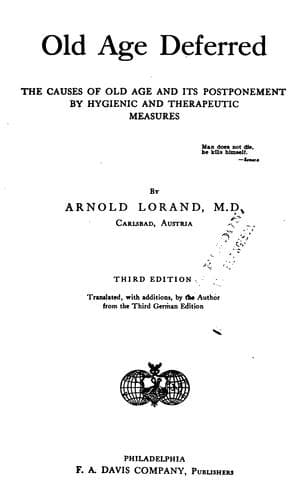
Old Age Deferred: The causes of old age and its postponement by hygienic and therapeutic measuresLorand, Arnold
Science
Old Age Deferred: The causes of old age and its postponement by hygienic and therapeutic measures
Lorand, Arnold
Hygiene; Longevity; Old age
Alcohol in small doses is unquestionably an excellent stimulant for the
nervous system and the circulatory apparatus. There are many people who
are able to do more work, especially of a physical nature, when they
take a certain amount of alcohol; and at the same time they have a
better appetite for food. Alcohol, however, is of more benefit in this
respect if we take wine; and of all alcoholic drinks, except beer, wine
contains the least percentage of alcohol, especially French wines, which
normally contain only 9 per cent. But this stimulating effect only holds
good when we do not take large amounts, for in the latter case the
quality of work is impaired, especially mental labor.
In a given quantity, and preferably in the shape of red wine, alcohol is
able to cheer us up, and to a certain extent diminish grief and sorrow;
but after taking large quantities we feel more depressed.
Beer is more nourishing than wine, but has a more sluggish effect.
English and some kinds of American beer often contain nearly as much
alcohol as some kinds of wine, sometimes more than light Tyrolean or
Italian wines.
The most beneficial form of alcohol is a light wine, and, as a medical
stimulant, the older vintages of French wines. Beer may, to some extent,
assist digestion, owing to its bitter constituents. It is true that it
contains the least percentage of alcohol of all beverages of this
nature, but it has the disadvantage that it is taken in larger
quantities as one gets accustomed to it, and thus more alcohol and a
larger amount of liquid may be introduced, the result of which may be
injurious to the circulatory system (see “Hygiene of the Food”).
Observation proves that many old people thrive well on a small amount of
claret or other red wine taken daily at meal times. In such cases it may
be regarded as a harmless tonic, if taken only in small quantities, and
if their health be otherwise normal except for the debility attributable
to old age. Dr. Savile, of London, has also found salutary effects from
moderate and exactly regulated quantities of alcohol in the aged inmates
of the workhouse infirmary.
In our judgment we shall be best guided by the way in which our regular
patients tolerate alcohol. When, having been accustomed to it all their
life, they ask for wine or whiskey, and they can tolerate it well, we
admit that small amounts act as a kind of tonic for them; but it should
never be given if there is an incompatibility for it, for then it is
distinctly harmful and should be avoided.
Brandy is the most dangerous form of alcohol,[310] but whiskey in small
doses may be reckoned much less harmful; but the least injurious of all
are light wines and the still lighter kinds of beer, which contain only
some 3 per cent. of alcohol.
Footnote 310:
Public-domain text, read in full here on John Shaqi.
Reviews
Reviews
No reviews yet
Be the first to share your thoughts on this work.
Elsewhere in the archive
Join the Discussion
Join the discussion
Sign in to leave a comment or review.
Sign InorCreate an account