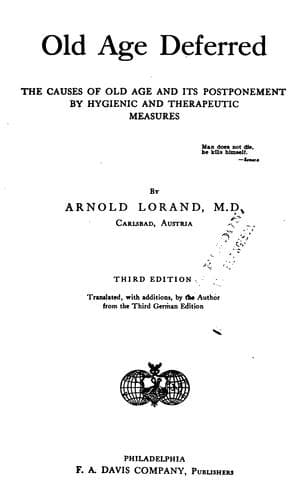
Old Age Deferred: The causes of old age and its postponement by hygienic and therapeutic measuresLorand, Arnold
Science
Old Age Deferred: The causes of old age and its postponement by hygienic and therapeutic measures
Lorand, Arnold
Hygiene; Longevity; Old age
There may be exceptions, however. The father-in-law of a Swedish lady
patient of ours is at present 96½ years old. For a good many years the
old gentleman has been drinking daily a large amount of cognac.
That wine may be taken without harm, even to considerable old age, can
be illustrated by a series of examples, of which we have mentioned some
already, where persons have reached 100 years of age in spite of
drinking wine every day. They might, perhaps, have lived longer had they
taken no alcohol, for, as a rule, such persons come from long-lived
families, and, as we have said previously, such people may permit for
themselves greater license in this respect; but this must be distinctly
regarded as the exception, for, as the statistics of the United
Temperance Association in England show, total abstainers have a much
greater chance for a long life than have others. According to Neisson’s
investigation of 6111 persons from 16 to 90 years of age who were taking
alcohol, the ratio of mortality among them was three times greater than
for the whole population of England.
Sir Isambard Owen shows, by a careful analysis of the results of the
Collective Investigation Returns, comprising 4287 persons, that the
average duration of life is greatest among total abstainers and very
moderate drinkers, and that but few addicted to much alcohol were among
the long lived; those in the latter condition can only expect a
shortening of life, which proves conclusively that alcohol is very
deleterious to the organism.
As post-mortem examinations show, all the organs of the body suffer
degeneration after coming in contact with large quantities of alcohol.
It would be impossible to dilate here upon all these different changes.
We will, therefore, only mention the effects of alcohol on the most
important organs—for example, the heart and blood-vessels.
As is well known, alcohol, if taken in large quantities, degenerates the
heart muscles and also produces the condition of arteriosclerosis. Its
effects on the brain are particularly deleterious. If taken once only,
but in large measure, it is sufficient to cause intoxication, with
changes in the mental faculty. Taken habitually, as by chronic
alcoholics, these mental changes may develop into a permanent character,
and thus insanity may follow. According to the official statistics of
the Kingdom of Württemburg, about 60 per cent. of the inmates of lunatic
asylums were alcoholics. Out of 579 lunatics of the Provincial Insane
Asylum, in Vienna, in 1899, there were 40 per cent. alcoholics.
Public-domain text, read in full here on John Shaqi.
Reviews
Reviews
No reviews yet
Be the first to share your thoughts on this work.
Elsewhere in the archive
Join the Discussion
Join the discussion
Sign in to leave a comment or review.
Sign InorCreate an account