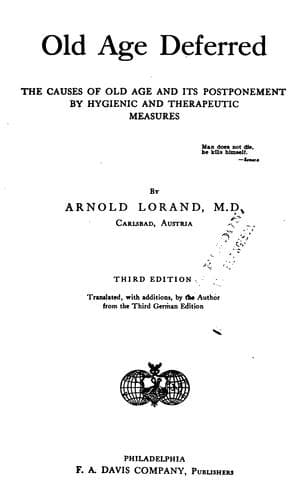
Old Age Deferred: The causes of old age and its postponement by hygienic and therapeutic measuresLorand, Arnold
Science
Old Age Deferred: The causes of old age and its postponement by hygienic and therapeutic measures
Lorand, Arnold
Hygiene; Longevity; Old age
Constipation or irregularity of the bowels is also common. There is
often great fatigue, slow speech, and an apathetic condition in both
these states. The memory shows the same typical deficiency, events of
long ago being more easily remembered than those of quite recent date.
The character of the patient becomes egotistical and avaricious. There
is great sensibility to cold and difficulty in keeping warm. The urine
is generally below the normal quantity; often it is scanty and of low
specific gravity, with retention of solid constituents. The processes of
oxidation are diminished both in typical myxœdema and in advanced old
age. There is a diminution of the blood-corpuscles and of hæmoglobin in
both conditions.
After the initial obesity in early myxœdema and old age, there comes as
a second stage a loss of fat, characteristic of the advanced stage of
myxœdema (the cachectic stage) and advanced old age.
There is an increase of fatty tissue after extirpation of the thyroid
gland, and later of connective tissue, just as in myxœdema and old age.
This increase of connective tissue is typical of old age. It first
appears in the arteries, leading to atheroma, and the typical symptoms
of arteriosclerosis. In myxœdematous persons, although they may still be
young, we find atheromatous arteries and arteriosclerosis. Impotence is
common in myxœdema, especially in advanced cases, and is also found in
senility, being more marked the greater the patient’s age.
There is no denying the fact that in old age we find, besides
degeneration of the thyroid, symptoms of degeneration in various other
tissues and functions, and the question now arises, whether these
changes in the tissues are really the sequel of previous degeneration of
the ductless glands, or whether both are only accidental and in no
causal relation We have already answered this question four years ago in
our communication to the Paris Biological Society, showing that old age
is due to degeneration of the ductless glands, and stating that these
glands govern the tissues and not _vice versa_. Still, we shall enter
here more fully upon this question, showing by experimental and clinical
evidence that the changes in the ductless glands are primary, and
followed by a degeneration of the tissues as a consequence.
We can produce experimentally typical symptoms of old age in young
animals by extirpation of the ductless glands, more especially the
thyroid, ovaries, and testicles.
When we extirpate the thyroid gland of an animal we get an increase of
fat in the subcutaneous tissue, or an increase of connective tissue. We
know of the case of a young bull which, two months after extirpation of
the thyroid, gained about thirty kilos in weight, due to an increase in
fat. The same thing occurred in a colt. We are indebted for our
knowledge of both these cases to Dr. Hertoghe, of Antwerp, the
well-known authority on the thyroid gland.
Public-domain text, read in full here on John Shaqi.
Reviews
Reviews
No reviews yet
Be the first to share your thoughts on this work.
Elsewhere in the archive
Join the Discussion
Join the discussion
Sign in to leave a comment or review.
Sign InorCreate an account