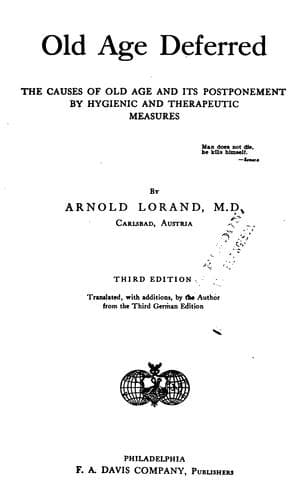
Old Age Deferred: The causes of old age and its postponement by hygienic and therapeutic measuresLorand, Arnold
Science
Old Age Deferred: The causes of old age and its postponement by hygienic and therapeutic measures
Lorand, Arnold
Hygiene; Longevity; Old age
After extirpation of the thyroid gland prominent writers have found a
diminution in the processes of oxidation; and by thyroid gland feeding
we can augment these processes, as was shown by Vermehren, Magnus-Levy,
Thiele, Nehring, and many others. This property of the thyroid gland is
made use of in the medicinal treatment of obesity. Since writing these
lines we have observed a loss of forty pounds in a man, a patient of
Professor Launois, of Paris, who, after this loss, felt better. We
treated him in Carlsbad for six weeks with thyroid extracts, and the
average loss was about a pound a day. True, this patient was also taking
Carlsbad water, but we have never seen so considerable a loss due to
this water alone. The diet of this patient had not been strict. This
loss of weight, then, is mainly to be ascribed to the thyroid treatment.
This treatment is dangerous, however, unless carefully regulated by a
physician.
Thus extirpation of the thyroid is undoubtedly in causal relationship to
obesity, which, as already mentioned, is often the first symptom of old
age. But it also can produce another sign of old age, and this is the
increase of connective tissue in the various organs and tissues. That
connective tissue formation is an attribute of old age has been clearly
shown by Demange and Oettinger, who found at every autopsy on old
persons an increase of connective tissue in the walls of the
capillaries. Ord and Mahomet found exactly the same thing in the
capillaries of persons suffering from myxœdema. This has been proved
experimentally by Professor Eiselsberg,[156] of Vienna, who found
atheromatosis of the aorta and other blood-vessels in dogs whose
thyroids he had removed.
Footnote 156:
“Die Krankheiten der Schilddrüse,” Stuttgart, 1901.
This increase in connective tissue has been found in various viscera
after removal of the thyroid; thus it was found by Kishi[157] in the
liver of one hundred and fifty dogs and monkeys. Rosenblatt and
Jeandelize[158] also described an interstitial hepatitis in similar
cases.
Footnote 157:
Virchow’s Archiv, p. 260, 1904.
Footnote 158:
Loc. cit.
The same change has also been noted in the kidneys after extirpation of
the thyroid (e.g., Blum[159] found an interstitial nephritis), and in
the brain an increase of neuroglia occurs, as observed by Blum, Walter
Edmunds, and others.
Footnote 159:
Blum: Loc. cit.
Increase of connective tissue in the skin is a common occurrence after
thyroid extirpation, and the name “myxœdema” is probably derived from
the fact that in some cases, as the disease advances, the connective
tissue is transformed into a mucinoid substance. The name “cachexie
pachydermatique,” as suggested by Charcot, seems to be far more
adequate.
Formation of fat and of connective tissue is not only seen after removal
of the thyroid, but can also be observed after extirpation of the sexual
glands, the ovaries and testicles.
Public-domain text, read in full here on John Shaqi.
Reviews
Reviews
No reviews yet
Be the first to share your thoughts on this work.
Elsewhere in the archive
Join the Discussion
Join the discussion
Sign in to leave a comment or review.
Sign InorCreate an account