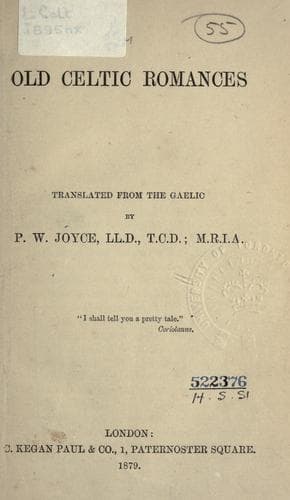
In the original Gaelic these are three poetical tales. All three have
been printed, with Gaelic text and literal translation, in the
Transactions of the Ossianic Society: the two first by the late John
O'Daly, and "Oisin in Tirnanoge" by Professor O'Looney. There are many
good copies of these tales in the manuscripts of the Royal Irish
Academy; though of not one of them have I seen a copy older than the
last century.
"The Chase of Slieve Cullinn" (commonly known as "The Poem of the
Chase") has been translated into English verse by Miss Brooke; and there
is another metrical translation in the _Irish Penny Journal_ (page 93).
And of "Oisin in Tirnanoge," Mr. T.D. Sullivan has given a graceful
poetical rendering in his volume of Poems, already mentioned.
PREFACE TO THE THIRD EDITION.
In this edition there is an additional tale, "The Fate of the Sons of
Usna," a notice of which will be found at page x, above.
LYRE-NA-GRENA, LEINSTER ROAD, RATHMINES, 1907.
FOOTNOTES:
[I.] In the Book of Leinster, a manuscript now in Trinity College,
Dublin, which was transcribed about the year 1130, there is a very
interesting list of ancient historic tales--187 in all--classified in
the manner indicated above, which an ollave was obliged to master, so as
to be able to repeat any one of them from memory, whenever his patron
required him to do so. (See O'Curry, "Lectures on the MS. Materials of
Irish History," pages 243 and 584.)
[II.] Macpherson never sinned in this way. He caught the true keynote;
and his "Poems of Ossian," however perverted in other respects, are
always dignified in thought and expression. Among other examples of the
true interpretation of the spirit of these old romances, prose and
poetry, I may mention Miss Brooke's "Reliques of Irish Poetry,"
published in the end of the last century; the Rev. Dr. Drummond's
"Ancient Irish Minstrelsy," published in 1852; Lady Ferguson's graceful
and interesting book, "The Story of the Irish before the Conquest"
(1868); and Mr. Standish O'Grady's ably written volume, the "History of
Ireland" (Vol. I., The Heroic Period 1878).
[III.] With one partial exception. In "The Book of the Dun Cow," "The
Voyage of Maildun" is divided into parts or chapters, which are numbered
on the margin in Roman numerals, each chapter relating to one particular
island; but no spaces are left, and the chapters have no headings. In
this tale I have followed the old sub-division.
[IV.] "Deirdrè," by Robert D. Joyce, M.D., M.R.I.A. Boston: Roberts
Brothers. Dublin: M.H. Gill and Son.
[V.] O'Curry, _Atlantis_, Nos. vii. and viii., page 390.
[VI.] See the ballad and air of "The Fairy King's Courtship," in the
author's "Ancient Irish Music," page 1.
CONTENTS.
THE FATE OF THE CHILDREN OF LIR; OR, THE FOUR WHITE SWANS.
CHAPTER PAGE
I. Bove Derg chosen King of the Dedannans, 1
Public-domain text, read in full here on John Shaqi.
Reviews
Reviews
No reviews yet
Be the first to share your thoughts on this work.
Join the Discussion
Join the discussion
Sign in to leave a comment or review.
Sign InorCreate an account