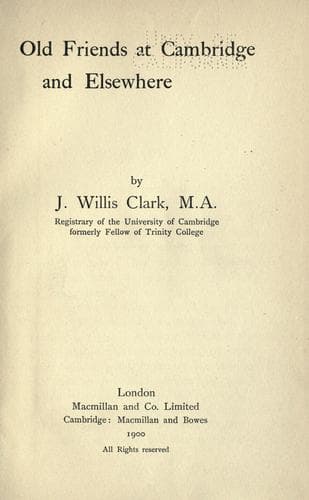
Old Friends at Cambridge and ElsewhereClark, John Willis
History
Old Friends at Cambridge and Elsewhere
Clark, John Willis
University of Cambridge -- History
shape of gratuitous literary work for his magazine rather than in
money.’ Milnes not only contributed himself, but ‘canvassed right and
left among his friends for contributions.’ Nor was his help confined to
the person whose work he valued. ‘The interest and friendship which the
genius had aroused,’ says Mr Reid, ‘was extended to his or her friends
and connexions. Many a widow and many an orphan had occasion to be
thankful that the husband or father had during his lifetime excited the
admiration of Milnes. Years after the death of Charlotte Brontë we find
him trying to smooth the path of her father, and to secure preferment in
the Church for her husband.’ This is only one instance out of many that
might be adduced. Again, he seemed to regard his critical faculty as a
trust for the benefit of others, and was never more congenially employed
than in drawing attention to some young poet who had no influential
friends. In proof of this we will only refer our readers to the touching
story of poor David Gray, whom he nursed with almost feminine
tenderness, and whose poem, _The Luggie_, he edited; and to his early
recognition of the genius of Mr Swinburne, to whose merits he drew
attention by an article in the _Edinburgh Review_. In close connexion
with this kind help to men of whom he knew little or nothing may be
mentioned his interest in the Newspaper Press Fund. The formation of
such a fund was strenuously resisted, we are told, by the most
influential members of the Press; but Milnes, from the first, brought
the whole weight of his social influence to its support, and
contributed, more than any other man, to its permanent and successful
establishment.
Nor should his kindness to young men be forgotten. He may have sought
their society in the first instance from the pleasure he took in all
that was bright, and entertaining, and unaffected; but, as we have
already tried to point out, his motives were commonly underlaid by some
serious purpose which it was not always easy to discover. We do not
maintain that he was specially successful in drawing young men out, for
his own talk was often scrappy, anecdotical, and difficult to follow;
still less do we mean that he tried to influence them in any particular
direction by improving conversation, or the enunciation of any special
opinions in politics or literature. But he certainly made his juniors
feel sure of his sympathy and his good-will.
Public-domain text, read in full here on John Shaqi.
Reviews
Reviews
No reviews yet
Be the first to share your thoughts on this work.
Elsewhere in the archive
Join the Discussion
Join the discussion
Sign in to leave a comment or review.
Sign InorCreate an account